The Lead Generation Process, From First Click to Client
Most lost sales happen between the enquiry and the deal. Here is the full lead generation process, and where businesses usually let good leads slip away.
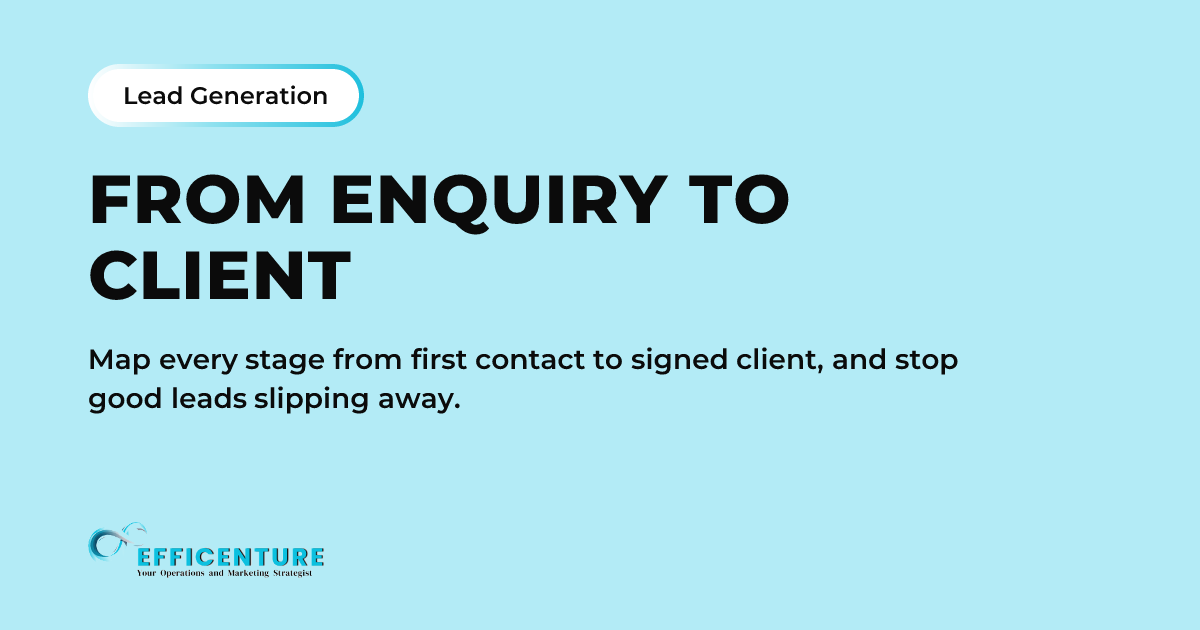
The lead generation process has seven stages: attract the right people, capture their interest as an enquiry, qualify whether they're a good fit, follow up quickly, nurture those who aren't ready yet, convert them into paying customers, and measure every stage so you can improve it. Most businesses focus on the first stage, getting more enquiries, while the biggest losses often happen later, in slow follow-up, poor qualification and leads that are never contacted again.
Thinking of lead generation as a process rather than a campaign helps you see where customers are lost and what to fix first. This guide works through each stage with practical examples.
Stage 1: Attract
The first stage brings potential customers into contact with your business.
Channels
- Search: SEO and Google Ads reach people actively looking for what you offer.
- Local search: your Google Business Profile reaches nearby customers on Google Maps.
- Social media: organic posts and ads build awareness and start conversations.
- Referrals: satisfied customers and partners recommend you.
- Outreach: direct contact with well-chosen prospects, common in B2B.
- Events and partnerships: associations, trade shows and joint activities.
What good looks like
You attract people who match your ideal customer, not just large numbers. A smaller flow of well-matched visitors is worth more than a big flow of the wrong ones.
Stage 2: Capture
Capture turns interest into an enquiry you can act on.
- Clear calls to action on every page and profile: "Send us a WhatsApp", "Request a quote", "Book a consultation".
- Several contact options, including WhatsApp, phone, forms and booking links.
- Short forms asking only what you need.
- An offer that gives people a reason to act now, such as a free assessment, a price guide or a site visit.
- Fast, mobile-friendly pages, since most visitors are on phones.
Where leads leak
Broken forms, WhatsApp links pointing to old numbers, slow pages and unclear next steps all lose leads before you ever see them. Test every contact route each month.
Stage 3: Qualify
Not every enquiry is a good fit. Qualification decides where to spend your time.
Simple qualification criteria
Agree on a few questions that show whether a lead is worth pursuing:
- Need: do they have a problem you solve?
- Fit: are they the type of customer you serve well?
- Budget: can they afford your service, or is there a realistic route to it?
- Timing: when do they want to act?
- Authority: are they the decision-maker, or can they bring the decision-maker in?
Practical ways to qualify
- Add one or two qualifying questions to your enquiry form, such as company size or budget range.
- Ask a short set of questions in the first WhatsApp reply or call.
- Publish price ranges, so poor-fit leads filter themselves out.
Label each lead as hot, warm or not a fit. Hot leads get immediate attention, warm leads go into nurturing, and poor fits get a polite, helpful reply.
Stage 4: Follow up
Follow-up is where many businesses lose the most.
- Speed: reply within minutes or the same hour during working hours. People often contact several businesses.
- Usefulness: answer their question, then suggest a clear next step.
- Channel: reply on the channel they used, then move to a call or meeting if that helps.
- Persistence: follow up two or three times if they don't respond, spaced over several days.
- Ownership: every lead should have a named person responsible.
An example follow-up sequence
- Within 30 minutes: reply with an answer, a qualifying question and a suggested next step.
- Next working day: a short follow-up with something useful, such as a relevant example or price guide.
- Three to five days later: a final check-in, offering to help when they're ready.
Stage 5: Nurture
Some good leads aren't ready to buy yet. Nurturing keeps you in their mind until they are.
- Stay in touch with useful updates, articles or offers, by email or WhatsApp, if they've agreed.
- Share relevant examples, such as a case study in their sector.
- Check in at natural moments, such as the start of a new budget year, a new season or a regulatory change.
- Keep notes, so whoever speaks to them next knows the history.
In B2B and high-value consumer purchases, such as property, education, solar or medical treatment, nurturing can matter as much as the first contact.
Stage 6: Convert
Conversion turns a qualified, interested lead into a paying customer.
- Make proposals clear: scope, price, timeline, payment terms and next steps.
- Remove friction: easy payment options such as M-Pesa Paybill or Till, card or bank transfer, and simple contracts.
- Address objections directly, whether about price, timing, risk or trust.
- Use proof: reviews, case studies, references and guarantees where appropriate.
- Agree a decision date and follow up on it.
Stage 7: Measure and improve
Measure each stage, so you know where to focus.
- Attract: visitors, impressions and reach by channel.
- Capture: enquiries by source and conversion rate from visit to enquiry.
- Qualify: share of enquiries that are good fits.
- Follow up: average response time and number of follow-ups.
- Nurture: leads re-engaged and later converted.
- Convert: share of qualified leads that become customers, and average deal value.
- Overall: cost per lead, cost per customer and customer value by channel.
Tools
- Google Analytics 4 for website enquiries by source.
- A CRM or lead log to track each lead through the stages.
- WhatsApp Business labels for conversations.
- A monthly review of the numbers with sales and marketing together.
Where should you start fixing?
Look at your numbers and find the weakest stage.
- Few enquiries: improve attraction and capture.
- Many enquiries, few good ones: tighten targeting and qualification.
- Good leads, slow replies: fix follow-up first. It's often the quickest win.
- Good conversations, few sales: improve proposals, pricing or objection handling.
- Leads go quiet: add nurturing.
Fixing a later stage often brings faster results than buying more traffic. Doubling the share of leads that become customers has the same effect as doubling your leads, usually at much lower cost.
An illustrative example
The numbers below are invented to show the method. A training provider in Nairobi gets 100 enquiries a month and enrols 8 students. Reviewing its lead log, it finds that half the enquiries wait more than a day for a reply, and almost nobody receives a second follow-up.
It sets a 30-minute response target, writes quick replies for common questions about fees and intake dates, and adds two follow-up messages for leads who go quiet. Three months later, with the same marketing spend, it enrols 14 students a month. Nothing changed at the attract stage. The gain came entirely from follow-up.
Who owns each stage?
A process only works if each stage has an owner. In a small business, one person may own several stages. In a larger one, ownership is often split.
- Attract and capture: marketing, or the agency running campaigns
- Qualify and follow up: sales, customer service or a dedicated lead handler
- Nurture: marketing, with sales input on timing
- Convert: sales or the business owner
- Measure: whoever owns reporting, reviewed jointly by marketing and sales
The most common gap is between marketing and sales. Marketing says it delivered leads. Sales says the leads were poor. Agree a shared definition of a qualified lead, a shared lead log and a monthly review, so both sides work from the same facts.
How do you write the process down?
Turn the stages into a one-page process map with each step, its owner, the target time and the tool used. For example: "New WhatsApp enquiry, customer service officer, reply within 30 minutes, WhatsApp Business with the New enquiry label, then add to the lead log." Train the team on it and review it quarterly.
How do you handle leads that say no?
A "not now" isn't always a final no. Record the reason, whether price, timing, a competitor or no need, and decide whether to nurture or close the lead. Leads lost on timing are often worth a check-in a few months later. Leads lost on price may respond to a smaller starting package. Reviewing lost reasons each month also shows patterns worth fixing, such as pricing that's out of line with the market or a common objection your proposals don't answer.
How Efficenture can help
Efficenture maps and improves the full lead generation process for Kenyan businesses, from attracting the right prospects to follow-up routines, CRM setup and monthly reporting. Learn more about our lead generation service, or see how operations management consulting supports better sales processes.
We're based in Nairobi and work with businesses across Kenya and East Africa. Book a consultation and we'll help you find where leads are slipping away.
Frequently asked questions
What are the stages of the lead generation process?
Attract, capture, qualify, follow up, nurture, convert and measure. Each stage can lose good leads, so track and improve them all, not just the number of enquiries.
What is lead qualification?
Qualification checks whether an enquiry is a good fit, usually by need, fit, budget, timing and decision-making authority. It helps your team spend time on the leads most likely to become customers.
What is lead nurturing?
Nurturing means staying in touch with interested leads who aren't ready to buy yet, through useful updates and timely check-ins, so they choose you when they are ready.
How many times should I follow up with a lead?
Usually two or three times over several days after the first reply, each with something useful. Stop if they ask you to, and record the outcome.
What is the most common weakness in lead generation?
Slow or inconsistent follow-up. Many businesses spend heavily on getting enquiries, then lose them by replying late or not following up at all.
Weekly Insights
One useful idea a week, on what you care about
A two-minute weekly briefing for growing businesses: the insight worth knowing on each topic you pick, why it matters, one thing to do that week, and the guides that go deeper. Unsubscribe any time.