Choosing a Lead Generation Company in Kenya
Lead generation providers range from ad agencies to call centres. Here is how to compare them, agree what a qualified lead is, and avoid paying for poor leads.
To choose a lead generation company in Kenya, first decide what kind of leads you need and how you'll judge their quality, then compare providers on how they generate leads, how they define a qualified lead, how they charge, and how transparent they are about sources and results. The right partner brings enquiries from people who match your ideal customer, uses methods that comply with Kenya's Data Protection Act, 2019, and reports on leads that become customers, not just the number of contacts delivered.
"Lead generation company" covers very different businesses. Some run online ads and landing pages. Some do cold calling or LinkedIn outreach. Some sell lists of contacts. Understanding the differences helps you choose well and avoid paying for leads that never convert.
What types of lead generation providers are there?
Digital marketing and ads agencies
They run campaigns on Google, Meta, LinkedIn or TikTok, build landing pages and send enquiries to your team. You usually own the ad accounts and see the data. Good for businesses with clear search demand or visual products.
SEO and content providers
They build long-term organic visibility so enquiries come through your own website. Slower to start, but leads keep coming without paying per click.
Outbound and appointment-setting firms
They contact prospects directly by phone, email or LinkedIn on your behalf, qualify interest and book meetings for your sales team. Common in B2B, especially for high-value services and software.
Call centres and telemarketing providers
They make outbound calls at scale, often for insurance, financial services, education and consumer products. Quality depends heavily on targeting, scripts and compliance.
Lead marketplaces and directories
They collect enquiries through their own platforms, such as comparison or listing sites, and sell them to businesses, sometimes to several competitors at once.
Data and list sellers
They sell contact lists. Be very careful. Bought lists are often outdated, and using personal data for marketing without consent or another lawful basis can breach the Data Protection Act.
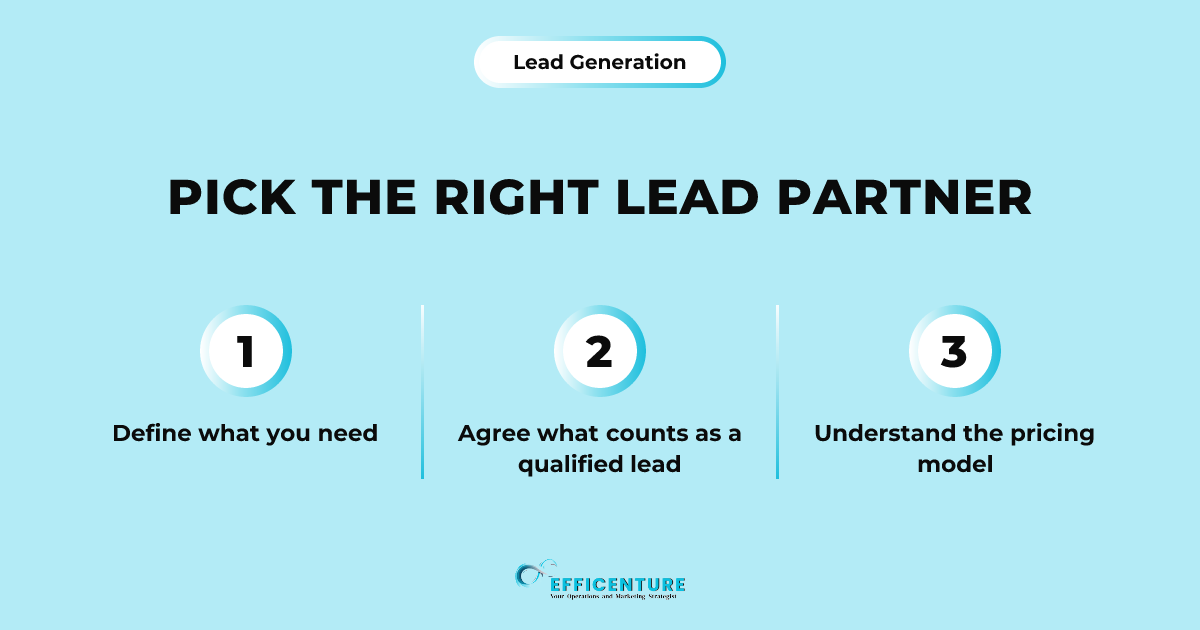
Step 1: Define what you need
Before speaking to providers, write down:
- Your ideal customer: industry, size, location and role for B2B, or demographics and needs for consumers.
- What a qualified lead looks like: for example, a business with more than 20 staff, based in Nairobi, with a stated need and a decision-maker involved.
- How many leads you can handle each month with your current team.
- What a customer is worth and what you can afford to pay per customer.
- Which channels you suspect will work, based on how your customers buy.
Step 2: Agree what counts as a qualified lead
This is the most important conversation you'll have with any provider. Without a shared definition, you'll argue about quality every month.
A good definition is specific and checkable:
- Matches agreed criteria for industry, size, location or need
- Has given accurate contact details
- Has knowingly asked to be contacted, or agreed to a meeting
- Hasn't been sold to other businesses at the same time, unless agreed
Agree also how disputed leads are handled, for example by replacing or crediting leads that don't meet the criteria.
Step 3: Understand the pricing model
Monthly retainer
A fixed fee for an agreed scope of work, such as running campaigns or outreach. Ad spend is usually separate. You carry the risk if results are poor, but you usually keep the data and assets.
Pay per lead
A fixed price for each lead delivered. Simple, but quality depends entirely on the definition of a lead. Watch for leads shared with competitors and for vague criteria.
Pay per appointment
Common in B2B outreach. You pay for each qualified meeting booked. Agree what counts as a qualified meeting and what happens with no-shows.
Performance or revenue share
Payment linked to sales. Rare, and only practical when sales can be tracked reliably.
Whatever the model, compare providers on cost per customer, not just cost per lead.
Step 4: Ask the right questions
- How exactly will you generate our leads? Which channels and methods?
- Where does the contact data come from, and how do you ensure consent?
- Are leads exclusive to us, or shared with other businesses?
- How do you define and check a qualified lead?
- What happens to leads that don't meet the criteria?
- Who owns the ad accounts, landing pages and lead data?
- What reports will we receive, and how often?
- Can we speak to two clients in a similar sector?
- What's the minimum contract period, and how can we end it?
Step 5: Run a pilot
Start with a short, clearly measured pilot, often one to three months, with:
- An agreed definition of a qualified lead
- A target number of leads or meetings
- Your own tracking of what happens to each lead
- A review at the end, based on leads that became opportunities and customers
Make sure your team is ready. Leads from any provider go cold fast if nobody follows up promptly.
Warning signs
- Very low prices per lead with vague quality criteria
- No explanation of where leads come from
- Unclear data sources or consent, which can create legal risk for your business
- Leads shared with competitors without your knowledge
- No access to the underlying data, such as ad accounts or campaign reports
- Long contracts with no performance review
- Pressure to buy large bundles of leads upfront
Should you outsource or build in-house?
Both can work.
Outsourcing makes sense when you need results quickly, lack in-house skills, or want to test a channel before investing in a team.
Building in-house makes sense when lead generation is central to your business, you have steady volume, and you want full control of data, messaging and relationships.
Many businesses combine the two: a provider runs campaigns or outreach, while the in-house team owns follow-up, qualification and the CRM. Whatever you choose, keep ownership of your accounts and customer data.
How do you judge a provider after three months?
Look beyond the number of leads:
- How many leads met the agreed criteria?
- How many became real opportunities, such as quotes or meetings?
- How many became customers, and at what cost per customer?
- Were reports clear, honest and on time?
- Did the provider improve the campaign based on feedback?
- Did your team follow up well, or were good leads wasted?
If cost per customer is comfortably below customer value, and quality is improving, the partnership is working.
What should the contract include?
Before signing, make sure the agreement covers:
- Scope: channels, activities and the number of leads or meetings targeted
- Lead definition: the written criteria for a qualified lead
- Exclusivity: whether leads are yours alone
- Data protection: how personal data is collected, stored and shared, and confirmation that consent or another lawful basis is in place
- Ownership: who owns ad accounts, landing pages, content and lead data
- Reporting: what you'll receive and how often
- Replacement or credits: for leads that don't meet the criteria
- Term and exit: minimum period, notice and what's handed over at the end
A clear contract protects both sides and avoids disputes about quality later.
How should your team work with the provider?
Share feedback on lead quality every week during the pilot. Tell the provider which leads became opportunities and which didn't, and why. Good providers use this to refine targeting and messaging. Without feedback, they can only optimise for volume.
Which industries use lead generation companies most?
In Kenya, lead generation providers are widely used in sectors where customers are valuable and competition is strong.
- Real estate: buyers, tenants and investors, including the diaspora
- Insurance and financial services: individual and business cover, savings and lending products
- Education and training: schools, colleges and professional courses
- Solar and energy: home and commercial installations
- B2B services: software, logistics, accounting, HR and IT
- Healthcare: clinics, specialists and wellness services
Each sector has its own rules on marketing and data, so choose a provider that understands yours.
How do you check a provider's claims?
Case studies and client logos are a start, not proof. Ask a reference client what the provider actually did, how lead quality held up after the first month, how they handled problems, and whether the client would hire them again. Ask the provider to show anonymised reports from a current campaign. If they can't show how they measure lead quality for existing clients, they're unlikely to measure it for you.
How Efficenture can help
Efficenture is a Nairobi-based lead generation and digital marketing consultancy. We run campaigns in your own accounts, agree a written definition of a qualified lead, set up tracking from enquiry to sale, and help your team follow up. Learn more about our lead generation service, or see our ads management.
We work with businesses across Kenya and East Africa. Book a consultation and ask us every question on the list above.
Frequently asked questions
What does a lead generation company do?
It finds potential customers for your business and passes their enquiries or meetings to your team. Methods include online ads, SEO, outreach, telemarketing and lead marketplaces.
How do lead generation companies charge?
Common models are monthly retainers, pay per lead, pay per appointment and, less often, revenue share. Compare providers on cost per customer, not just cost per lead.
Is it legal to buy leads in Kenya?
It depends on how the data was collected. Using personal data for marketing without consent or another lawful basis can breach the Data Protection Act, 2019. Ask every provider where their data comes from and how consent was obtained.
What is a qualified lead?
A lead that meets agreed criteria, such as matching your ideal customer, having a real need, giving accurate contact details and asking to be contacted. Agree a written definition with any provider.
Should I outsource lead generation?
Outsourcing helps when you need results quickly or lack in-house skills. Keep ownership of your accounts and data, and make sure your team handles follow-up well.
Weekly Insights
One useful idea a week, on what you care about
A two-minute weekly briefing for growing businesses: the insight worth knowing on each topic you pick, why it matters, one thing to do that week, and the guides that go deeper. Unsubscribe any time.