Building a Sales Funnel for Small Business Growth
A clear guide to building, running, and measuring a small business sales funnel that converts prospects into paying clients consistently.
A sales funnel for a small business is a step-by-step process that guides potential buyers from their first interaction with your brand through to a completed transaction and beyond. It maps out how strangers discover your services, express interest, evaluate your offers, and decide to purchase.
Building a functional funnel gives your company a systematic way to attract potential buyers, capture contact details, and systematically convert inquiries into predictable revenue.
When you understand how your customers move from attention to action, you can spend your marketing budget where it actually drives revenue. If you are setting up commercial acquisition systems for the first time, read our guide on how to start lead generation for a small business to build a solid foundation.
What is a sales funnel for a small business?
A sales funnel for a small business is the operational path that a prospective customer follows as they move from discovering your products or services to becoming a paying client. It acts as a filter, sorting casual observers from qualified prospects who have real buying intent.
Unlike enterprise corporations with large marketing teams, a small business needs a funnel that works cleanly without constant manual intervention. The funnel tracks every milestone in a buyer journey, helping you identify exactly where prospects drop off so you can fix broken steps.
For service providers, manufacturers, and regional traders, the funnel creates order out of random inquiries. It replaces guesswork with clear actions for every inbound message, lead form submit, and phone call.
The 5 practical stages of a small business sales funnel
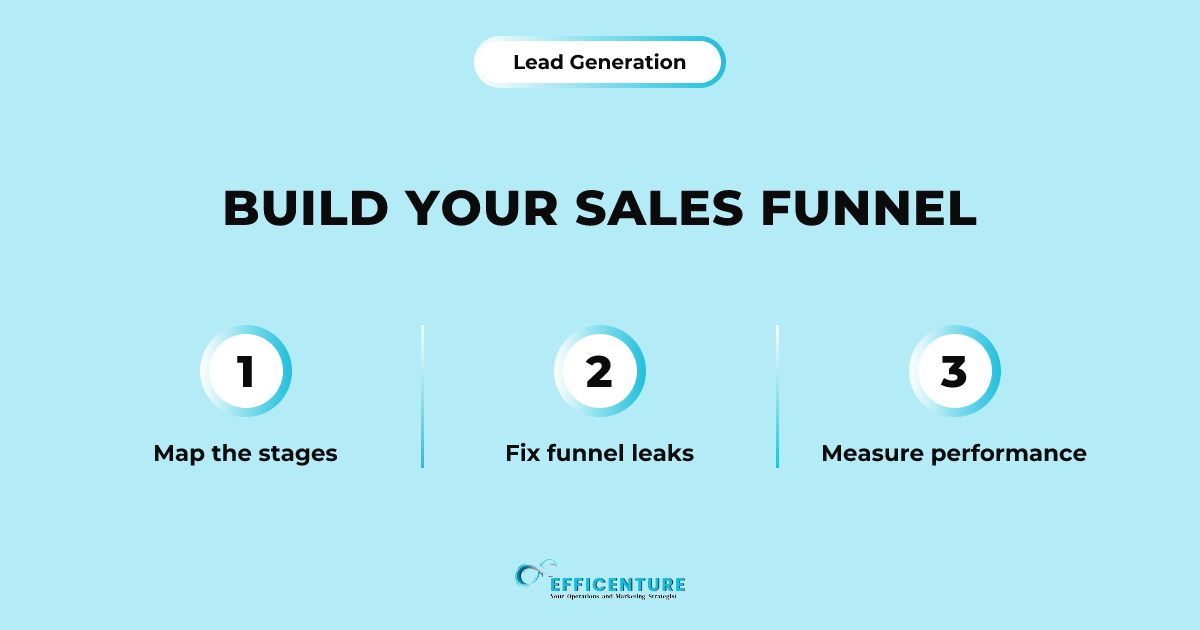
A small business sales funnel consists of five main stages: Awareness, Capture, Evaluation, Conversion, and Retention. Each stage requires specific marketing activity and messaging to keep prospects moving forward.
While traditional corporate models list four generic steps, small growing businesses benefit from splitting the pipeline into operational milestones that match real buying behavior.
1. Awareness (Attracting targeted traffic)
At the top of the funnel, prospective buyers realise they have a problem or need. They encounter your brand through search engines, social channels, referral networks, or paid advertising.
Your goal here is not an instant sale, but getting seen by people who fit your ideal customer profile. For example, a commercial solar installer in Nakuru might use local search ads to target factory managers searching for energy cost reduction.
2. Capture (Turning traffic into identified leads)
Once visitors find your business, you must convert anonymous attention into contact details. This happens when a prospect trades their phone number, email address, or WhatsApp contact for something useful.
High-converting capture points include price lists, project cost calculators, consultation bookings, or detailed product catalogues. Without a capture mechanism, top-of-funnel traffic leaves without a trace.
3. Evaluation (Qualifying intent and building trust)
In the evaluation stage, leads compare your company against alternatives, review your pricing, and evaluate your reliability. They check your customer reviews, inspect your past projects, and evaluate your response time.
This stage is where your sales team or automated messaging nurtures the relationship. For a specialized company, targeted lead generation services help structure this process so qualified prospects get immediate follow-up while unqualified inquiries are filtered out early.
4. Conversion (Closing the sale)
The conversion stage occurs when the qualified lead makes a commitment and makes a payment. For B2B firms, this means signing a contract or paying a initial deposit. For B2C firms, it means checking out online or confirming an order via M-Pesa.
Reducing friction at this point is critical. Clear invoices, direct payment options, transparent tax receipts through eTIMS, and simple agreements help leads cross the finish line without hesitation.
5. Retention (Securing repeat purchases and referrals)
The funnel does not stop at the first transaction. Existing customers cost significantly less to market to than acquiring brand-new prospects.
This final stage focuses on delivery quality, onboarding support, and structured follow-up. Satisfied clients buy again, upgrade their packages, and refer new prospective accounts directly into the top of your funnel.
How to build a sales funnel step by step
To build a sales funnel for a small business, define your ideal buyer, build a focused lead capture page, design a valuable initial offer, set up automated nurture communications, and establish clear sales follow-up procedures.
Following a structured build sequence prevents wasted ad spend and ensures your internal team can handle incoming leads promptly.
Step 1: Define your target buyer and core offer
Before launching campaigns, clarify who your prospective buyer is and what specific solution they need. Avoid trying to serve everyone, and narrow your focus to the buyers who bring the highest lifetime value and lowest operational headache.
Create a direct headline offer that solves an immediate pain point. A regional logistics firm in Mombasa might offer a quick fleet rate calculator rather than a generic brochure.
Step 2: Build a focused landing page
Direct your campaign traffic to a dedicated landing page designed around a single action. Standard website pages often confuse visitors with too many menu options and competing links.
Your landing page should state your value proposition clearly, display proof of work, and present one prominent call to action. Applying systematic conversion rate optimization practices to landing pages ensures that more of your paid or search traffic converts into named contacts.
Step 3: Implement immediate lead intake channels
Small business buyers in East Africa expect fast response times. Offer lead capture mechanisms that align with local communication habits, particularly direct phone options and WhatsApp integration alongside traditional email forms.
Ensure that every lead form entry or WhatsApp click triggers an automated confirmation message while alerting your internal sales representatives instantly.
Step 4: Construct a nurture email and message sequence
Not every lead is ready to buy on day one. Set up a simple automated sequence of three to five messages over two weeks to educate your leads.
Use these messages to share case studies, address common buying objections, clarify warranty or delivery terms, and invite the prospect to book a call or request a custom quote.
Step 5: Establish clear sales follow-up protocols
Automation handles information delivery, but closing sales often requires human interaction. Define standard timelines for calling back new inquiries.
If a prospect fills out a consultation request, your representative should call within thirty minutes during business hours. A rapid response dramatically improves your conversion rate from inquiry to closed deal.
Common leaks in a small business sales funnel and how to fix them
Sales funnel leaks occur when potential buyers drop out of your pipeline due to slow response times, unclear pricing, complex buying steps, or lack of structured follow-up.
Identifying and repairing these broken points directly improves your revenue without increasing your ad spend.
+-------------------------------------------------------------------+
| TYPICAL SALES FUNNEL LEAKS |
+-------------------------------------------------------------------+
| 1. High Ad Spend -> Unfocused Landing Page -> Traffic leaves |
| 2. Lead Form Submitted -> Delayed Follow-up -> Prospect buys elsewhere |
| 3. Proposal Sent -> No Structured Tracking -> Deal stalls |
+-------------------------------------------------------------------+
Slow initial follow-up response
When a lead submits an inquiry, their intent is at its peak. Waiting twenty-four hours to call back allows them to research competitors and make commitments elsewhere.
The Fix: Use automated instant notifications via SMS or WhatsApp to notify your sales reps the second a lead arrives. Set a firm internal SLA (Service Level Agreement) to contact all leads within an hour.
Friction in the payment and decision step
If your final closing stage requires tedious paperwork, hidden taxes, or awkward payment steps, buyers hesitate. In regional markets, requiring slow bank transfers for simple deposits stalls deals.
The Fix: Provide simple, transparent pricing structures up front. Integrate direct M-Pesa till or paybill numbers alongside traditional card and bank settlement options to make payment frictionless.
Pitching the purchase too early
Requesting a high-value purchase on the first interaction pushes prospects away. Buyers need to feel confident in your reliability before committing significant capital.
The Fix: Break your offer down into logical stages. Ask for a low-friction initial step first, such as a site audit, a sample order, or a low-cost discovery package. If you suspect your funnel is dropping qualified prospects, run our free marketing audit to identify operational gaps across your intake channels.
Tools and software needed to run a small business sales funnel
Running a small business sales funnel requires an aligned set of tech tools, including a user-friendly landing page builder, a reliable Customer Relationship Management (CRM) system, and email marketing software.
You do not need expensive software suites to get started, and you should choose tools that integrate easily with your existing operations.
| Funnel Function | Standard Tool Category | Recommended Operational Focus |
| :--- | :--- | :--- |
| Traffic Acquisition | Paid Search & Social Ads | Targeted intent platforms (Google Ads, Meta) |
| Capture & Pages | Landing Page Builder / CMS | Fast loading, mobile-optimised forms |
| Lead Storage | CRM (HubSpot, Zoho, Pipedrive) | Centralized lead status tracking |
| Automated Nurture | Email & WhatsApp Automation | Triggered, personalized follow-ups |
| Analytics | Tag Tracking & Reporting | Conversion event tracking |
When choosing tools, ensure they can store customer details centrally so your marketing and sales personnel work from the exact same prospect list.
How much does it cost to build a sales funnel in Kenya?
Building a sales funnel for a small business in Kenya requires an initial setup cost, depending on whether you configure it internally or hire a specialist agency. Running the funnel incurs recurring operational costs for ad spend, software subscriptions, and content management.
Understanding these setup and recurring costs allows small business owners to plan their budgets accurately. For a detailed breakdown of regional marketing investments, read our article on how much digital marketing costs in Kenya.
Initial setup expenses
- Landing Page Development: KES 35,000 to KES 120,000 for custom design, copywriting, and mobile optimisation.
- CRM & Automation Setup: KES 25,000 to KES 100,000 for pipeline configuration, email template creation, and workflow triggers.
- Tracking & Analytics Setup: KES 15,000 to KES 50,000 for Google Analytics, tag manager, and conversion goals setup.
Ongoing monthly operations
- Software Subscriptions: KES 5,000 to KES 30,000 per month for CRM seats, email platforms, and domain hosting.
- Ad Media Spend: KES 30,000 to KES 250,000+ per month depending on your target industry and market reach across East Africa.
How to measure and optimise your funnel performance
Measuring a sales funnel involves tracking specific key performance indicators (KPIs) at every stage to see how efficiently prospects transition into paying clients.
Tracking raw numbers gives you the exact data required to optimize campaigns without guessing.
Top-of-Funnel Conversion Rate = (Total Captured Leads / Total Page Visitors) x 100
Sales Conversion Rate = (Total Paying Customers / Total Qualified Leads) x 100
Customer Acquisition Cost (CAC) = Total Ad & Sales Spend / Total New Customers
Key metrics to monitor weekly
- Traffic Volume: The number of unique visitors reaching your entry points.
- Lead Conversion Rate: The percentage of visitors who leave their contact information.
- Cost Per Lead (CPL): Total advertising spend divided by the total number of leads captured.
- Sales Opportunity Rate: The percentage of captured leads who meet your qualification criteria.
- Customer Acquisition Cost (CAC): Total sales and marketing expenditure divided by total closed sales.
To track these indicators accurately across web pages and paid ad channels, implement systematic analytics and reporting software. Connecting your web analytics directly to your CRM provides total clarity on which campaigns produce real client revenue.
Aligning sales and marketing execution
A sales funnel fails when marketing generates leads that sales teams ignore, or when sales teams complain that incoming leads are completely unqualified. Funnel alignment ensures both functions work toward the same financial targets.
Define a clear Qualified Lead standard together. Marketing should only pass leads to sales when the prospect meets agreed criteria, such as verified budget, immediate timeline, or specific location.
Sales representatives must commit to updating lead statuses in the CRM after every phone call or meeting. This feedback loop allows marketing to double down on campaigns that bring high-converting traffic while pausing non-performing channels.
Build a predictable lead generator with Efficenture
Efficenture helps growing businesses build dependable acquisition engines. Operating from Nairobi, we design, implement, and manage end-to-end sales funnels for companies across Kenya, East Africa, and international markets.
We align your traffic campaigns, landing pages, CRM systems, and sales processes to eliminate dropped leads and increase conversion rates.
If you are ready to construct a clear pipeline that turns market attention into verified commercial contracts, explore our lead generation services or speak directly with our consulting team via Call or WhatsApp at +254 714 146 122.
Sales funnel FAQs
What is the main difference between a sales funnel and a sales pipeline?
A sales funnel looks at the customer's journey, tracking how potential buyers move through stages from initial awareness down to conversion rates across the whole audience. A sales pipeline focuses on the salesperson's actions, tracking specific deals as they move through operational stages like qualification, proposal sent, negotiation, and closed won.
How long does it take to see results from a new sales funnel?
Initial lead generation results can appear within days of launching paid advertising into a completed landing page. However, full funnel optimization takes between two and three months of continuous data collection to refine lead nurture messaging, improve sales conversion rates, and lower your customer acquisition costs.
What is a lead magnet, and does my small business need one?
A lead magnet is a valuable piece of free content or an incentive offered to potential buyers in exchange for their contact details, such as a PDF buyer guide, pricing calculator, free audit, or discount voucher. Small businesses need lead magnets to give visitors a compelling reason to identify themselves before they leave the website.
How is a B2B sales funnel different from a B2C sales funnel?
B2B sales funnels typically feature longer buying cycles, higher financial transaction values, and multiple decision-makers, requiring detailed educational content, custom proposals, and direct sales calls. B2C sales funnels are generally shorter, focus on emotion and immediate convenience, and rely heavily on quick digital checkout processes.
Frequently asked questions
What is the main difference between a sales funnel and a sales pipeline?
A sales funnel looks at the customer's journey, tracking how potential buyers move through stages from initial awareness down to conversion rates across the whole audience. A sales pipeline focuses on the salesperson's actions, tracking specific deals as they move through operational stages like qualification, proposal sent, negotiation, and closed won.
How long does it take to see results from a new sales funnel?
Initial lead generation results can appear within days of launching paid advertising into a completed landing page. However, full funnel optimization takes between two and three months of continuous data collection to refine lead nurture messaging, improve sales conversion rates, and lower your customer acquisition costs.
What is a lead magnet, and does my small business need one?
A lead magnet is a valuable piece of free content or an incentive offered to potential buyers in exchange for their contact details, such as a PDF buyer guide, pricing calculator, free audit, or discount voucher. Small businesses need lead magnets to give visitors a compelling reason to identify themselves before they leave the website.
How is a B2B sales funnel different from a B2C sales funnel?
B2B sales funnels typically feature longer buying cycles, higher financial transaction values, and multiple decision-makers, requiring detailed educational content, custom proposals, and direct sales calls. B2C sales funnels are generally shorter, focus on emotion and immediate convenience, and rely heavily on quick digital checkout processes.
Weekly Insights
One useful idea a week, on what you care about
A two-minute weekly briefing for growing businesses: the insight worth knowing on each topic you pick, why it matters, one thing to do that week, and the guides that go deeper. Unsubscribe any time.