Ads ·
Ads on ChatGPT Now: Practical Guide for Growing Businesses
OpenAI is introducing sponsored content and product placements into ChatGPT conversations. Here is how your business can prepare technically and strategically.
ChatGPT now serves sponsored responses, suggested product links, and brand recommendations directly within user conversations. OpenAI integrates these ads based on dialogue context rather than isolated search keywords. This creates a distinct format where paid promotions sit alongside AI answers. For a breakdown of basic ad locations and formats, see our guide on where ChatGPT ads appear in user conversations.
This shift changes how buyers research products, services, and commercial providers online. Instead of scrolling through ten blue links on a search engine, users receive synthesised answers. When commercial intent is detected, sponsored options appear directly inside that answer flow.
Growing businesses must understand how to structure campaigns, organise product data, and balance paid placements with organic citations. Renting visibility inside AI interfaces requires a different operational setup than standard search engine marketing.
What paid ads on ChatGPT mean for your business
The arrival of ads on ChatGPT means your business can present paid offers precisely when a user asks an AI model for buying advice. Sponsored placements trigger based on the full dialogue history rather than single keywords.
When a potential client asks the model to compare enterprise accounting tools or recommend logistics providers, sponsored options can display alongside organic citations. This format places your brand directly in the consideration phase of a customer research process.
This capability alters how digital acquisition strategies work for expanding companies. Users view AI responses with high trust because the interface presents reasoned answers. If your ad appears within that conversational thread, it gains immediate visibility, provided the offer matches the user prompt.
Businesses in East Africa targeting regional or global clients need to prepare their technical infrastructure now. Operating paid campaigns on conversational platforms requires clear data feeds, updated digital channels, and defined attribution pathways. You can review how our specialised ChatGPT ads service helps brands manage this transition.
How conversational ad triggers work compared to traditional keywords
Conversational ad triggers rely on semantic context and user intent rather than simple exact-match keywords. The AI evaluates the entire dialogue thread, user preferences, and query nuance before deciding whether to serve a sponsored response.
Traditional search advertising relies on bid auctions tied to specific phrases like solar panel installer or HR software provider. ChatGPT ads analyse the complete prompt. If a user asks how to reduce operational electricity costs for a dairy factory in Nakuru, the system understands the location, industry, and core problem.
Understanding prompt context over isolated keywords
AI models process language through intent vectors. They determine whether a user wants pure information, direct troubleshooting, or a commercial purchase.
Ads trigger primarily when the dialogue signals commercial interest or a request for supplier options. If a user asks a purely theoretical question, ads remain hidden. Once the prompt shifts toward purchasing, hiring, or sourcing, sponsored placements enter the thread.
Managing query depth and commercial intent signals
Users rarely ask single-word queries in conversational AI. They ask multi-layered questions, refine their parameters, and upload context documents or specifications.
Your campaign management must account for these multi-step interactions. Bidding on broad terms yields poor efficiency because the AI requires rich context to match your offer accurately. Campaign targeting focuses on problem categories, user job functions, and specific application scenarios rather than basic search queries.
Businesses seeking to adapt their acquisition mix can explore our wider search engine marketing services to align traditional paid search with new conversational channels.
Preparing your product data and feeds for ChatGPT ads
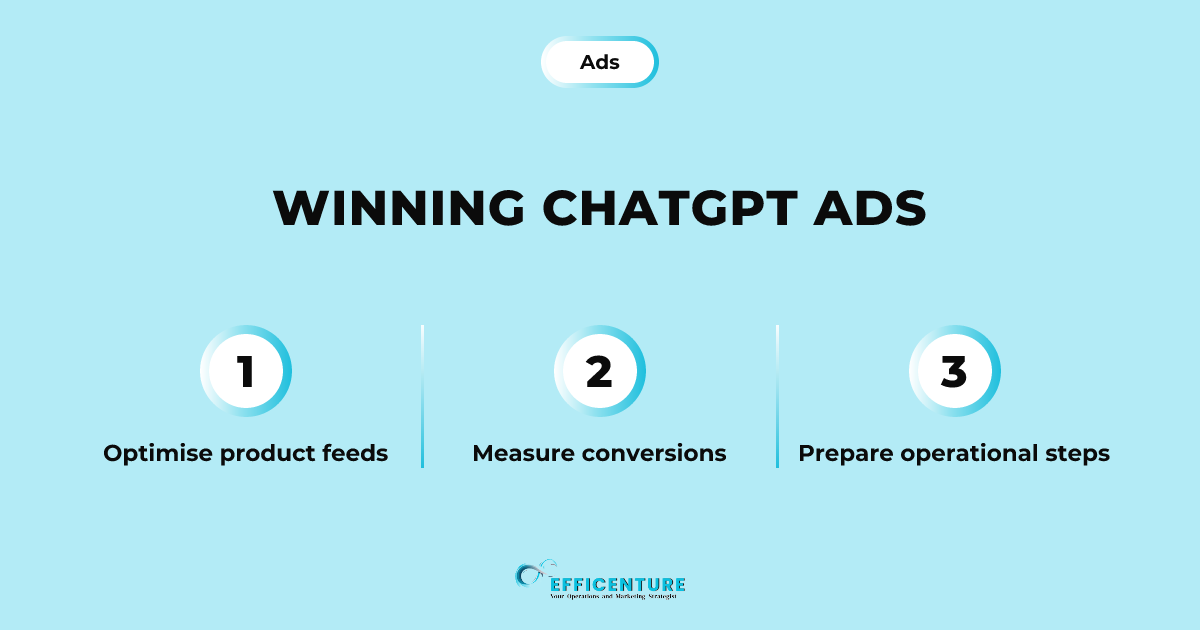
Product-feed ads on ChatGPT require structured, clean, and real-time inventory data so the AI can retrieve accurate pricing, specs, and stock status. Without proper technical feed architecture, your sponsored products will fail to render correctly in conversational outputs.
When ChatGPT displays a recommended product, it pulls information from structured product catalogues. If your business sells physical goods, commercial equipment, or standardised service packages, your data feed must meet modern schema standards.
Structuring feed attributes for AI engines
Standard ecommerce feeds usually include a title, price, image link, and basic description. AI search interfaces require deeper attribute mapping to answer complex user queries.
Your product feed should include detailed technical specifications, compatible use cases, clear geographical availability, and exact currency indicators like KES or USD. If you sell solar inverters, the feed must detail output wattage, battery compatibility, warranty terms, and installation requirements. The AI uses these precise fields to verify that your product answers the user prompt.
Aligning product descriptions with natural language queries
Marketing copy written solely for traditional search algorithms often sounds repetitive or stuffed with keywords. AI platforms require clear, descriptive, and fact-focused prose.
Write product descriptions that explain what the item does, who it serves, and what operational problem it solves. Clear technical specifications perform far better than generic promotional claims.
Ensure your backend order processing system integrates directly with your catalogue. If a user clicks a product link inside a ChatGPT dialogue, the landing page must instantly reflect the exact stock level, price, and delivery options described in the chat. You can verify your tracking and landing page readiness using our conversion tracking services.
Choosing between paid ChatGPT ads and organic AI citations
A complete AI search strategy uses paid ads for immediate visibility while building organic citations for long-term presence across conversational tools. Relying on only one approach limits your market reach.
Industry analysis around conversational media often debates whether brands should pay for direct placements or earn organic recommendations inside AI answers. A detailed exploration of this topic can be found on The HOTH, which examines how paid inventory compares against earned AI recommendations.
The case for paid ChatGPT ad placements
Paid ads offer immediate exposure. You control the message, the targeted offer, and the destination link.
When launching a new service, entering a new regional market, or clearing stock inventory, organic optimisation takes time to index and build authority inside AI models. Paid placements bypass that waiting period, putting your business directly in front of active prospective buyers.
The case for earned organic AI citations
Organic AI search visibility occurs when the underlying AI models crawl your published content, whitepapers, press releases, and structured data, using them as trustworthy reference sources. When users ask unsponsored questions, the AI names your business organically.
Earned citations build credibility because users recognise that the model pulled the reference from authoritative technical documentation. However, achieving consistent organic citations requires authoritative content publishing, robust technical markup, and widespread digital mentions.
Combining both channels into a dual-track strategy
High-performing companies do not choose between paid ads and organic citations. They execute both simultaneously.
Paid ads capture immediate commercial demand for competitive search terms. Simultaneously, ongoing optimisation ensures your site serves as a primary source for organic answers. Review our practical guide to AI search optimisation to see how organic citation strategy complements paid media.
Measuring conversions and ROI from ChatGPT advertising
Measuring return on spend from ChatGPT ads requires custom attribution setups because user paths in conversational search differ from linear web browsing. Buyers frequently ask multiple follow-up questions before clicking a link.
A standard website click from Google or Facebook usually follows a direct path where the user sees an ad, clicks a link, lands on a page, and completes a form. In ChatGPT, a user might interact with a sponsored recommendation, ask two more clarifying questions within the same chat, and only then click the destination URL.
Setting up tracking parameters for conversational clicks
Proper tracking depends on clean URL structures and custom parameters. Use explicit tagging on every link provided to OpenAI's ad system.
Standard UTM parameters must label the source as chatgpt, the medium as cpc or sponsored_answer, and the campaign name by specific problem category. This distinction separates conversational AI traffic from standard paid search or organic direct visits in your reporting software.
Evaluating lead quality from AI referral paths
Traffic originating from conversational search often displays higher intent than standard display or social traffic. Because users articulate complex criteria before receiving your ad link, those who click have already passed initial self-qualification filters.
Track downstream metrics carefully:
- Form completion rate on custom landing pages.
- Sales pipeline velocity for incoming leads.
- Average deal size comparing AI referrals to standard search referrals.
- Total customer acquisition cost across conversational campaigns.
Implementing robust tracking models ensures you allocate media budgets efficiently. Learn how to configure your analytics stack properly with our GA4 implementation service.
If you want an objective review of your existing campaign tracking and website conversion setup, request a free marketing audit from our consultancy team.
Operational steps before launching your first campaign
Before spending money on ChatGPT ads, your business must establish clear internal processes to capture, convert, and fulfil incoming demand. Spending budget on AI placements without operational readiness wastes capital.
Running ads on modern conversational interfaces will send highly informed prospects to your sales team or ecommerce store. If your internal operations lag, buyers quickly exit and return to the chat interface for an alternative supplier.
Auditing your website technical infrastructure
Your destination pages must load rapidly, present immediate proof of value, and offer clear conversion paths. Ensure your mobile experience is flawless, as many conversational AI interactions occur on mobile apps.
Ensure your site markup uses schema.org protocols. When the AI model validates your landing page after a user clicks, clear structured data helps maintain relevance signals.
Aligning internal inventory and sales response procedures
If your campaign promotes professional services or B2B solutions, establish strict response protocols for incoming enquiries. Prospective clients who use AI tools expect rapid digital responses.
For product businesses, verify your real-time inventory systems. If a user asks ChatGPT for commercial catering equipment available for immediate delivery in Eldoret or Kisumu, and your ad confirms availability, your stock database must match that claim.
Establishing structured campaign budgets
Start with controlled test budgets to evaluate click costs, user engagement, and actual conversion rates. Define your baseline target cost per acquisition before expanding expenditure.
Set clear testing allocations in local currency, such as testing with KES 50,000 to KES 150,000, depending on target industry competitiveness and audience location. Measure exact performance metrics before scaling your monthly media commit.
Managing campaign performance requires continuous review of back-end conversion flows. Discover how our operations management consulting aligns sales operations with media expenditure.
Getting started with your ChatGPT advertising strategy
Running new ad formats requires combining technical media buying with rigorous internal operations. As OpenAI expands sponsored capabilities within ChatGPT, early adopters who prepare their data feeds, landing pages, and measurement systems stand to build a distinct advantage.
At Efficenture, we help businesses build profitable customer acquisition systems across digital channels. Based in Nairobi, we work with mid-market and growing companies across Kenya, East Africa, and international markets to deploy high-performing media campaigns backed by solid operational infrastructure.
If you are ready to explore conversational search ads, integrate your product feeds, or audit your digital readiness, visit our ChatGPT advertising services page to see how we work. You can also call or message our consulting team directly on +254 714 146 122 to discuss your growth plans.
Frequently asked questions
Can any business advertise on ChatGPT now?
Availability depends on regional rollout phases and platform eligibility criteria established by OpenAI. Businesses with structured product feeds, clear service offerings, and transparent landing pages are best positioned to leverage these ad formats as inventory opens up globally.
How do ChatGPT ads differ from Google Search ads?
Google Search ads display based on specific phrases entered into a search box. ChatGPT ads display based on the context of an ongoing conversation, where the AI evaluates prompt history, commercial intent, and user needs to insert relevant sponsored responses or product links naturally into its dialogue.
What technical requirements are needed to run product feed ads on ChatGPT?
You need a structured digital catalogue containing detailed product attributes, live stock availability, explicit pricing, high-quality media links, and structured schema markup on your target web pages so the AI model can verify specifications.
How much do ChatGPT ads cost for businesses?
Advertising costs vary based on target industry, market audience, competitive auction dynamics, and campaign bidding structures. Businesses typically start with controlled testing budgets to measure cost per click and acquisition efficiency before scaling media spend.
Weekly Insights
One useful idea a week, on what you care about
A two-minute weekly briefing for growing businesses: the insight worth knowing on each topic you pick, why it matters, one thing to do that week, and the guides that go deeper. Unsubscribe any time.