Business Process Improvement: A Practical Guide
Learn how business process improvement helps growing companies fix operational bottlenecks, reduce waste, and build reliable workflows.
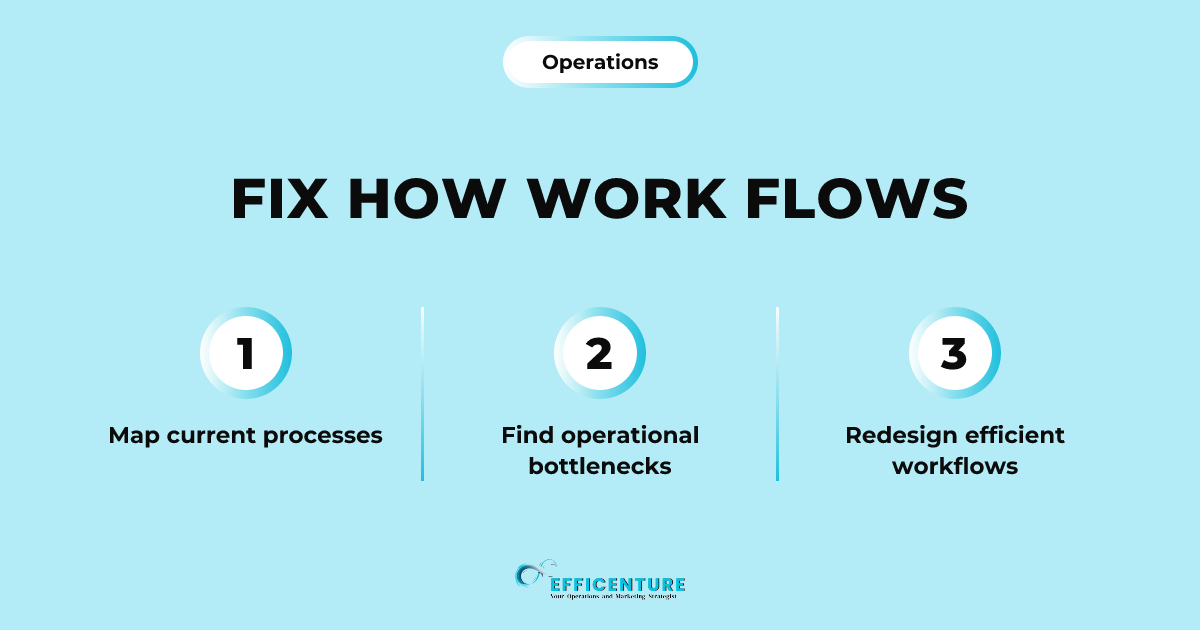
Business process improvement means systematically reviewing how work gets done inside your company to remove waste, reduce delays, and lower operational costs. When orders stall, customer complaints pile up, or staff members spend hours moving data between spreadsheets, your processes need fixing before you spend money on new software. Operations management consulting provides structured methods to analyse these internal workflows and turn them into reliable routines.
Many business owners respond to administrative friction by hiring more staff or purchasing expensive software packages. Adding headcount to a broken workflow only increases your wage bill without fixing the underlying confusion. Software installed over poor routines simply automates errors, generating mistakes at a higher speed.
True process work looks at what your staff actually do from Monday to Friday. It examines how customer enquiries from WhatsApp move to sales logs, how invoices move through KRA eTIMS, and how dispatch notes reach your boda boda drivers. When you clean up these steps, your team spends less time fixing mistakes and more time serving clients.
What is business process improvement?
Business process improvement is the practice of evaluating existing company workflows to make them simpler, faster, and more cost effective. It involves documenting each step of a task, finding where errors or delays happen, and redesigning the steps so the work flows smoothly from start to finish. For a distribution company, this might mean changing how stock requests move from the warehouse floor to the accounts desk.
Consider how a typical order moves through a mid-sized business. A customer sends a message on WhatsApp requesting ten cartons of goods. The salesperson notes the order on a notepad, calls the warehouse supervisor to check stock, types an invoice into an accounting tool, and waits for a director to approve credit terms. Each step represents a point where information can be lost, delayed, or misrecorded.
When you ignore your processes, small inefficiencies compound into large losses over time. Staff members develop workarounds that hide problems rather than fixing them, and new employees take weeks to learn basic tasks. Overlap between roles causes friction, especially when two departments assume the other is responsible for sending payment receipts or updating inventory ledgers.
By contrast, a clear approach to operational efficiency helps you reduce operating costs in a small business in Kenya without cutting staff or service quality. You eliminate steps that add no value, clear out duplicate data entry, and establish standard routines that work every day. The focus stays entirely on delivering what the customer paid for without burning through operational cash.
How to map your current business processes
Mapping your current business processes requires sitting down with the staff who actually do the work to draw out every step from start to finish. You start by identifying the trigger event that begins a task, such as receiving a customer order via WhatsApp or email. Then you record every person who touches that order, what decisions they make, and where the file goes next.
Do not conduct this mapping exercise behind closed doors in a board room. Directors and senior managers often describe how a job ought to be done, which rarely matches daily reality on the ground. A manager might believe an invoice takes ten minutes to produce, unaware that the accounts clerk spends two hours cross-referencing M-Pesa Paybill statements against bank deposits manually.
Bring together administrative staff, sales officers, warehouse clerks, and dispatch drivers for short mapping sessions. Use sticky notes on a wall or a whiteboard to lay out the sequence of steps. Encourage staff to be completely honest about informal workarounds, personal spreadsheets, and manual phone calls they use to get work done.
Watch out for hidden steps that never appear in official job descriptions. These include personal reminder notes, secondary verification calls, and manual transcription between systems. When staff spend hours checking each other's work because they do not trust the data, you have found a process in urgent need of mapping and repair.
Step-by-step process mapping
- Define the start and end points of a specific workflow, such as onboarding a new client or dispatching a delivery across town.
- Interview the team members who perform the tasks daily, as managers often write processes the way they wish they happened rather than how they actually happen.
- Draw the sequence on a whiteboard or paper using simple boxes for actions and diamonds for decisions.
- Mark every point where work stops and waits for approval, payment, or data entry from another department.
- Record the time each step takes, noting both the active working time and the waiting time between tasks.
- Document every tool, paper form, spreadsheet, or communication channel used at each step along the pathway.
- Identify every handover point where responsibility transfers from one employee or department to another.
- Review the completed map with the entire team to confirm that it accurately reflects daily operational reality.
Once you have your map on paper, the bottlenecks become obvious. You will often spot duplicate data entry, unnecessary sign off layers, and missing handovers that leave clients waiting for days. For example, you might discover that three different employees manually record the same Till number payment into three separate spreadsheets.
This visual clarity allows you to isolate structural problems from individual employee performance. When work stalls, the fault usually lies in the system design rather than staff effort. This exercise also forms the foundation for writing clear standard operating procedures for small businesses in Kenya that your team can follow without constant supervision.
Where do operational bottlenecks hide?
Operational bottlenecks in growing businesses usually hide in handovers between departments, manual data re-entry, and slow payment approvals. A common bottleneck occurs when sales teams take orders on the road but cannot update inventory levels instantly, leading to promised deliveries that the warehouse cannot fulfil. Another frequent delay happens when finance teams must physically sign paper vouchers before petty cash or mobile money disbursements can happen.
Payment reconciliation creates severe friction in many local firms. When customers pay through Safaricom Paybill or Till numbers, accounts clerks often spend hours matching transaction codes to pending invoices. If the payment reference field contains a phone number instead of an invoice number, the order waits while staff call the client to verify the payment owner.
KRA eTIMS compliance presents another common choke point for growing companies. When sales teams issue manually written receipts, accounts staff must re-type every line item into the tax system to generate compliant electronic tax invoices. If the original receipt lacks a tax PIN or customer details, the whole billing workflow grinds to a halt while staff chase down missing information.
Logistics and delivery handovers frequently expose process gaps. Orders cleared by accounts at noon might sit in the dispatch office until late afternoon because nobody notified the boda boda riders or drivers. A clear workflow connects payment confirmation directly to dispatch scheduling, reducing hold-ups at the loading bay.
You can spot these friction points by measuring how long tasks take from start to finish and asking staff where they feel most frustrated during their shifts. When you take a free marketing audit or review your internal operations, look for steps where work piles up in a single person's inbox. Removing these blockages speeds up your service delivery and cuts down the overtime costs caused by delayed administrative work.
How to redesign workflows for better efficiency
Redesigning workflows involves removing redundant steps, combining similar tasks, and automating repetitive data transfers between systems. You should challenge every step by asking why it exists and whether the customer or business truly benefits from it. If a report is generated every week but nobody reads it, stop producing it immediately.
Start your redesign by grouping tasks logically around customer outcomes rather than departmental boundaries. Instead of having an order pass through four different desks for verification, assign a single operator to manage the entire workflow from receipt to dispatch. Cross-training staff members to handle adjacent tasks eliminates unnecessary handovers and reduces waiting times.
Examine your approval thresholds to ensure they reflect current operational costs. Requiring senior partner approval for minor expense vouchers or small office supplies creates unnecessary administrative queues. Delegating routine decisions to line managers within defined limits keeps daily work moving smoothly.
Look closely at how data travels between your communication channels and administrative records. If client orders arrive through WhatsApp, set up standardised order forms that collect all required information at the first point of contact. This prevents back-and-forth messaging to clarify physical addresses, contact numbers, or payment terms.
Practical redesign rules
- Eliminate approval steps that add no real risk control, such as requiring a director to sign off on routine purchases under a set amount.
- Standardise templates and checklists so staff do not reinvent formatting for invoices, quotations, or client reports.
- Move manual record keeping into shared digital tools where multiple team members can view updates in real time.
- Automate data entry between payment gateways and internal accounting ledgers to reduce manual matching errors.
- Create clear escalation rules so staff know exactly who handles exceptions without stalling routine orders.
- Consolidate communication channels so customer requests flow into a central record rather than private messaging accounts.
When redesigning your operations, make sure your marketing and sales departments talk to your fulfillment teams. Poor coordination between customer acquisition and operational delivery creates broken promises that damage your reputation. Fixing the gap between marketing and operations ensures that the volume of work your sales team brings in matches what your operations team can actually process.
How to implement process changes with your team
Implementing process changes successfully depends on involving your team early and training them thoroughly on the new steps before enforcing them. When staff members feel that management is imposing rules from above without understanding their daily pressures, they will quietly revert to their old habits. You need to explain the reasoning behind the changes, showing how the new workflow saves them time and reduces frustration.
Resistance to new processes usually stems from fear of technology or concern over job security. Address these concerns directly by demonstrating how simplified routines eliminate tedious manual entry rather than replacing people. When staff see that new systems reduce late evening hours spent balancing books or chasing receipts for chama records, they become willing partners in the transition.
Start by testing the new process with a single team or a specific product line for two weeks. Gather feedback from the staff involved, iron out any unexpected snags, and adjust the procedure before rolling it out company wide. Consistent communication and patience during this transition period prevent resistance and build a culture of continuous operational improvement.
Provide clear written documentation and quick reference sheets at work desks during rollout. Run short practical practice sessions where staff walk through actual customer scenarios using the new workflow. Monitor compliance daily during the first month, praising team members who adopt the new procedures and supporting those who struggle.
Working with an operations consultancy
Working with an operations consultancy helps you get an objective view of your internal processes without the bias that builds up inside a growing company. External consultants bring experience from working across different sectors in East Africa, allowing them to spot inefficiencies that internal teams might overlook after years of working the same way. They help you prioritise which processes to fix first based on financial impact and ease of implementation.
Internal managers often find it difficult to challenge long-standing habits maintained by senior colleagues or founder directors. An external team provides impartial analysis, grounding recommendations in operational data rather than office politics. This external perspective helps untangle complex procedural disputes between department heads.
If your team is stretched thin trying to manage day to day service delivery while struggling with operational delays, professional support can speed up your internal restructuring. To discuss how we can help you fix your workflows and build sustainable systems, reach out for operations management consulting. You can call or send a message on WhatsApp at +254 714 146 122 to speak with our team directly. We are based in Nairobi and work with businesses across Kenya, East Africa and beyond.
Frequently asked questions
What is business process improvement?
Business process improvement is the practice of analysing current company workflows to remove waste, reduce delays, and lower operational costs. It involves documenting tasks, identifying bottlenecks, and redesigning steps so work moves smoothly.
Why do operational bottlenecks happen?
Operational bottlenecks usually occur during handovers between departments, during manual data re-entry, and when payment approvals require physical signatures. They create delays that frustrate clients and increase labour costs.
How do I map my business processes?
You map processes by interviewing the staff who perform the daily tasks, defining start and end points, and drawing out every step and decision on paper. This visual representation highlights where work stalls.
When should a business hire an operations consultant?
A business should hire an operations consultant when internal teams are too busy with daily firefighting to fix broken workflows or when operational delays are hurting profitability. An external view helps identify hidden inefficiencies faster.
Weekly Insights
One useful idea a week, on what you care about
A two-minute weekly briefing for growing businesses: the insight worth knowing on each topic you pick, why it matters, one thing to do that week, and the guides that go deeper. Unsubscribe any time.