East Africa Business Growth Strategy: Operations Guide
Sustainable regional growth requires more than market research; it demands standard operating procedures, clear workflows, and tight financial management across every location.
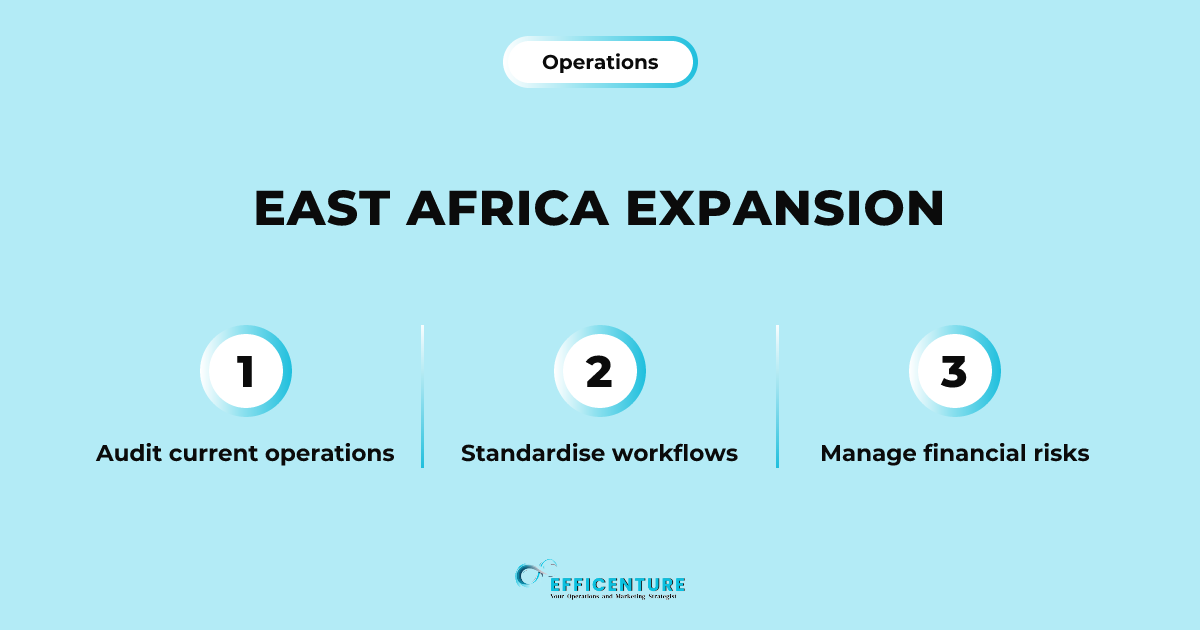
A successful business growth strategy requires an operational model that maintains quality, speed, and cash flow control as you scale across borders. While economic reports emphasize regional market potential, practical expansion fails when internal workflows, inventory management, and reporting systems break down under multi-site demands.
Building a repeatable operational framework allows your company to capture new commercial opportunities without degrading your existing revenue base. To scale efficiently across regional markets, you must align internal workflows with external market opportunities.
What breaks when expanding a business?
Business expansion fails most often due to operational friction, fragmented management visibility, and unaligned delivery workflows rather than a lack of market demand. When companies scale into new territories, existing management processes struggle to maintain service quality and margin discipline across distant teams.
Macroeconomic reports detail regional expansion opportunities, but executive teams often overlook the practical friction of managing multi-site operational structures. Growing companies routinely encounter three primary operational bottlenecks.
Loss of operational visibility
Head office leadership often loses clear tracking of daily performance, stock movements, and customer satisfaction levels once operating across multiple offices. Without centralized operational reporting, regional units begin using inconsistent practices that compromise product quality.
Uncoordinated working capital strain
Regional distribution demands higher holding stock, longer payment collection cycles, and additional legal compliance steps. For example, maintaining statutory compliance such as eTIMS integration in Kenya alongside distinct tax filing deadlines in neighboring territories requires tight cash flow tracking to prevent liquidity shortages.
Process fragmentation
Teams in different branches adapt systems informally, leading to mismatched customer experiences, uneven service delivery, and duplicate administrative effort. What works for a single location frequently collapses when managing multiple branches under different local dynamics.
If your operational core is unstable in your primary market, scaling will only multiply existing inefficiencies across your new locations. You can assess your operational readiness by reading our guide on how to scale a small business in Kenya.
How do you build an operational model for regional growth?
An operational model for regional growth defines how resources, technology, management authority, and daily workflows are structured between your central headquarters and operating branches. The most effective structure balances centralized governance over core processes with controlled local autonomy for day-to-day execution.
To design an operational model that scales cleanly, structure your business around three structural pillars.
Centralized control functions
Keep high-risk and administrative control functions centralized to maintain regulatory compliance and margin oversight. These centralized activities include overall financial management, core brand standards, software stack administration, and primary vendor negotiations.
Regional execution frameworks
Allow local teams to manage customer relationship delivery, local partner logistics, and frontline sales within strict operational boundaries. Define clear authority limits for discounts, contract approvals, operational spending, and local staff hiring.
Standardized technology backbones
Use shared enterprise resource systems, centralized databases, and uniform reporting structures. Every branch must record inventory levels, sales leads, customer feedback, and daily expenses through identical digital workflows.
Engaging structured operations management consulting helps leadership teams map these workflows, remove operational bottlenecks, and design organizational structures capable of handling multi-market execution.
How should you standardise operating procedures across markets?
Standardising operating procedures across markets means documenting clear, step-by-step instructions for every recurring revenue, service, and administrative task so that operational quality remains uniform regardless of branch location. Written standards eliminate reliance on individual memory and allow new regional staff to onboard rapidly.
Building scalable operating standards across multiple locations requires a systematic approach.
Map primary revenue and delivery processes
Document how value flows through your business from initial customer contact to payment collection and account offboarding. Focus on high-frequency activities like order processing, service dispatch, vendor onboarding, product quality checks, and invoice reconciliation.
Define measurable quality metrics
Assign target turnaround times, acceptable error thresholds, and customer satisfaction indicators to each step. For example, specify that client support tickets must receive an initial response within 30 minutes and resolution within 24 hours.
Implement structured auditing
Review branch compliance against written operating procedures monthly. Use operational checklists to verify that field staff follow required safety, administrative, and reporting procedures without shortcutting internal control measures.
For detailed instructions on structuring procedures for growing businesses, consult our step-by-step manual on standard operating procedures for small businesses in Kenya.
How do you align marketing capacity with regional operations?
Aligning marketing capacity with regional operations ensures that your sales and marketing campaigns generate client leads only at the rate your operational delivery team can serve effectively. Uncoordinated commercial pushes create order backlogs, broken delivery deadlines, customer churn, and damaged brand reputation.
To synchronise customer acquisition with operational capacity, try three practical steps.
Establish capacity-based campaign triggers
Set digital media and campaign spending limits based on active fulfillment bandwidth. If field installation teams, technical staff, or product distribution channels reach 85 percent operational capacity, hold campaign acceleration until operational bandwidth opens up.
Connect payment gateways to sales workflows
Integrate immediate settlement tools like M-Pesa business tills and direct bank transfers directly into your order tracking platforms. This speeds up order validation and ensures service fulfillment begins immediately upon payment confirmation without manual accounting delays.
Run joint sales and operations reviews
Hold weekly operational syncs between commercial leadership and operations managers. Evaluate incoming lead velocity against current inventory levels, staffing schedules, and logistical limits before approving additional commercial expansion budgets.
If you want to evaluate whether your current growth setup balances client acquisition with operational fulfillment, request a review through our free marketing and operations audit.
What supply chain and technology setup supports regional scaling?
A technology and supply chain framework for regional scaling uses centralized cloud applications, real-time inventory tracking, and integrated software platforms to manage stock, operational data, and team communication across distant sites. Unified enterprise software prevents data silos and gives executive leadership a real-time picture of business performance.
Building an enterprise software architecture involves four core operational building blocks.
Centralized enterprise software
Replace isolated spreadsheets with integrated cloud platforms that connect accounting systems, inventory management, customer relationship management, and human resources into a single source of truth.
Real-time inventory tracking
Deploy stock management software that records inventory movement instantly across warehouses and branches. Establish automated reorder points based on real-world delivery lead times rather than manual physical counts.
Digital audit trails
Ensure every financial transaction, inventory issuance, and client contract approval leaves a timestamped digital record. This reduces internal fraud risks, clarifies operational accountability, and simplifies compliance audits across tax jurisdictions.
Improving foundational systems and internal workflows before expanding protects your profit margins. Review practical techniques for optimising core workflows in our guide to business process improvement in Kenya.
How do you manage financial and operational risk across regions?
Managing financial and operational risk across regional business units requires setting strict cash management rules, maintaining working capital reserves, and enforcing regulatory compliance audits across all operating entities. Unmanaged expansion can drain capital from profitable home operations to support underperforming regional units.
Mitigate operational and financial risk using four practical management practices.
Establish dedicated working capital reserves
Reserve sufficient cash reserves to cover at least six to nine months of operational overhead for each new regional site. Regional expansion takes longer to break even than local additions due to brand awareness build-up and local market learning curves.
Implement strict credit controls
Do not extend loose trade credit terms to new regional clients. Use milestone payments, upfront deposits, or escrow arrangements until account creditworthiness is proven through reliable payment histories.
Standardize cost-reduction mechanisms
Control overhead costs early by renting shared logistics facilities, utilizing third-party contract logistics providers, and standardising hardware procurement across all branch offices.
Understanding cost management helps protect baseline profits during aggressive growth phases. Learn practical cost-control tactics in our article on how to reduce operational costs in a small business in Kenya.
How to audit your operations before executing a growth strategy
Auditing your operations before executing a growth strategy involves evaluating your current systems, team capacities, digital tools, and financial health against specific operational benchmarks. Conducting this assessment prevents expanding pre-existing operational weaknesses into new geographic markets.
Use this practical six-point checklist before committing capital to regional expansion.
1. Process documentation audit
- Are core delivery processes fully documented in accessible standard operating procedures?
- Can a new team member complete routine tasks using existing documentation without direct supervisor assistance?
2. Technology integration review
- Do your CRM, accounting, and inventory platforms sync data automatically without manual entry?
- Can executive leadership access real-time performance metrics across all active locations within one dashboard?
3. Supply chain stability assessment
- Are your primary suppliers capable of scaling delivery volume by 50 percent without increasing defect rates or lead times?
- Do you have back-up vendors established for critical input materials and services?
4. Working capital stress test
- Can your business maintain cash flow balance if regional accounts receivable collections take 60 days instead of 30?
- Is your home market cash flow insulated from regional expansion expenses?
5. Quality control verification
- Are error rates, return rates, and customer service resolution times tracked daily?
- Is there a clear protocol for escalating client complaints from branch offices to headquarters?
6. Measurement and reporting infrastructure
- Are key operational performance metrics defined and tracked through automated reporting tools?
Setting up clear tracking metrics and reporting systems ensures management retains operational control while scaling. Learn how to establish clean performance benchmarks by exploring our measurement strategy services.
How Efficenture helps you structure your regional expansion
Executing a successful regional business growth strategy requires translating expansion plans into reliable operational systems, optimised workflows, and structured management reporting. Without strong operational backbones, expanding across borders leads to lost margins, inconsistent client experiences, and internal management burnout.
At Efficenture, based in Nairobi, we work with business owners, managing directors, and operations leads to build practical operational structures that support sustainable growth. We clean up inefficient workflows, establish standard operating procedures, align marketing spend with operational delivery, and implement clear performance tracking frameworks.
If you are preparing your business for regional scaling or need to fix operational bottlenecks holding back your current growth strategy, contact Efficenture today on +254 714 146 122 or explore our operations management consulting services to schedule a practical working session.
Frequently asked questions
What is the biggest operational challenge in a business growth strategy?
The biggest operational challenge is maintaining consistent delivery quality, process compliance, and cash flow visibility across multi-site locations. As businesses expand, fragmented communication, uncoordinated stock management, and manual workflows often erode profit margins. Building standardized operating procedures and centralized reporting systems solves this problem.
How do standard operating procedures help regional growth?
Standard operating procedures provide clear, written instructions for core business tasks, ensuring that service quality, billing, and customer delivery remain uniform regardless of branch location. They shorten employee onboarding time, reduce operational error rates, and allow founders to delegate daily execution safely.
Should expanding businesses centralize or decentralize management operations?
Growing businesses should adopt a hybrid approach that centralizes core governance functions while decentralizing day-to-day execution. Core functions like financial management, brand standards, technology stack selection, and primary vendor contracts should remain centralized. Frontline customer service, local sales activities, and immediate operational dispatch can be managed locally within defined authority limits.
How much working capital reserve is needed for business expansion across regional markets?
Business owners should maintain a minimum working capital reserve covering six to nine months of operational overhead for each new branch office. Regional market entry often involves longer payment collection cycles, regulatory registration delays, and supply chain lead times that require financial buffering before local operations reach breakeven.
Weekly Insights
One useful idea a week, on what you care about
A two-minute weekly briefing for growing businesses: the insight worth knowing on each topic you pick, why it matters, one thing to do that week, and the guides that go deeper. Unsubscribe any time.