How to Scale a Small Business in Kenya
Growth that outpaces your systems brings errors, stress and cash problems. Here is how to build a business that can serve more customers without breaking.
To scale a small business in Kenya, build the systems that let you serve more customers without costs and problems growing at the same rate. That means documenting key processes, freeing the founder from daily decisions, hiring and training well, controlling cash flow, growing demand steadily through channels you can measure, and tracking a few numbers that show whether growth is healthy. Scaling isn't just getting bigger. It's getting bigger while staying profitable and in control.
Many Kenyan businesses grow quickly at first, then hit a wall. The founder works longer hours, errors increase, customers complain, cash gets tight despite rising sales, and good staff leave. The cause is usually that the business grew faster than its systems. This guide sets out how to avoid that.
What's the difference between growing and scaling?
A business grows when revenue rises. It scales when revenue rises faster than costs and effort.
If doubling sales means doubling staff, doubling the founder's hours and doubling the error rate, the business has grown but not scaled. If it can handle twice the customers with better systems, a slightly larger team and a stable workload for the founder, it has scaled.
Signs you're growing faster than your systems
Watch for these warning signs. Two or three together usually mean it's time to fix systems before pushing for more sales.
- The founder works longer hours every month and can't take leave.
- Customers wait longer for quotes, deliveries or replies than they used to.
- Errors and complaints rise along with sales.
- Staff are busy all day but key tasks still slip.
- Nobody is sure who is responsible for certain decisions.
- Cash is tight even in months with strong sales.
- Good employees leave, citing stress or confusion.
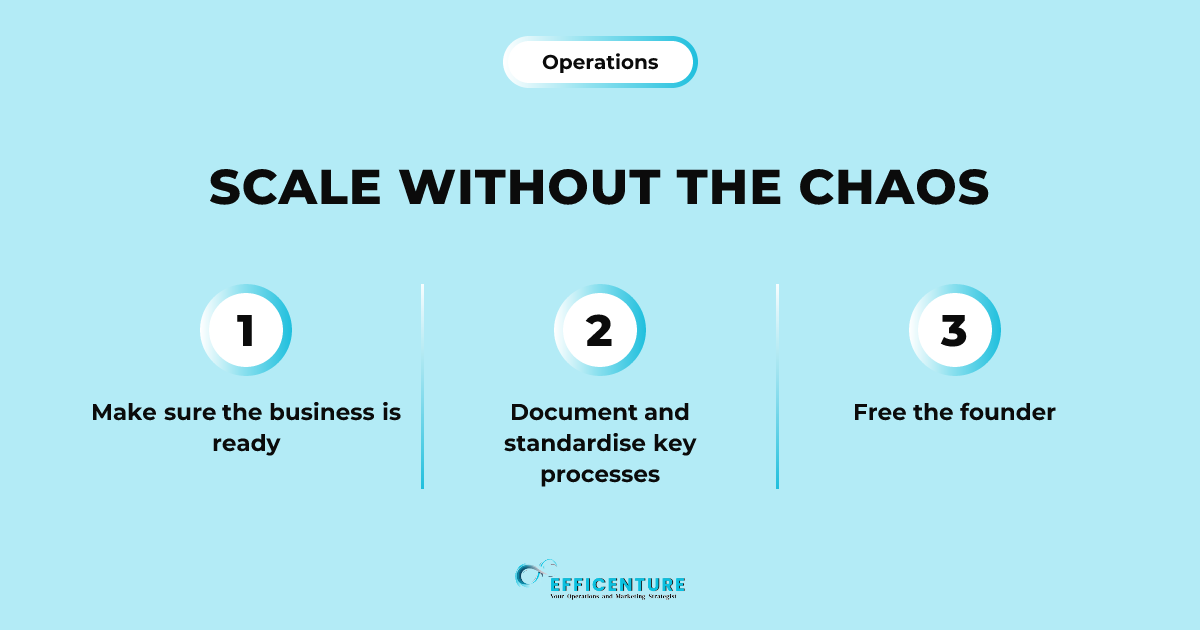
Step 1: Make sure the business is ready
Before pushing for growth, check the foundations.
- Is the core offer profitable? Know your margin on each product or service. Scaling a loss-making offer just makes bigger losses.
- Do customers come back or refer others? Strong repeat and referral rates suggest the offer works.
- Can you deliver consistently? If quality depends on who handles the job, fix that first.
- Is cash flow under control? Growth usually needs cash before it brings cash in.
Step 2: Document and standardise key processes
Systems are what let a business scale. Start with the processes that affect customers and money.
- Map how work moves from enquiry to delivery and payment.
- Write standard operating procedures for key tasks, so anyone trained can do them to the same standard.
- Use checklists for tasks where mistakes are costly.
- Standardise your offers where you can. Custom work for every client is hard to scale.
Step 3: Free the founder
In many small businesses, the founder is the main bottleneck. Every quote, approval, complaint and decision goes through them. This limits growth to the founder's capacity.
- List what you do each week, and mark what only you can do.
- Delegate the rest, with clear SOPs and decision limits. For example, staff can approve discounts up to a set amount, and only larger ones come to you.
- Build a management layer, even a small one, as the team grows.
- Spend your time on the work that grows the business: strategy, key relationships, major sales and building the team.
Step 4: Hire and train well
Scaling needs people, but hiring too fast or badly creates new problems.
- Hire for roles, not just tasks. Define what each role is responsible for and how success is measured.
- Hire ahead of the crunch where you can, so new staff are trained before demand peaks.
- Onboard properly, using SOPs and a structured first few weeks.
- Keep good people with fair pay, clear growth paths and recognition.
- Comply with employment law, including contracts and statutory deductions. Problems here grow with the team.
Step 5: Control cash flow
Growth often strains cash. You may need to buy stock, hire staff or invest in equipment before customers pay.
- Forecast cash for the next three to six months, not just profit.
- Invoice promptly and follow up on late payments.
- Negotiate terms with suppliers and large clients that support your cash cycle.
- Separate business and personal money, if you haven't already.
- Plan financing early. Banks and other lenders are more helpful when you approach them before you're in difficulty.
Step 6: Use technology where it helps
The right tools let a small team do more.
- Accounting software for invoicing, expenses and tax records, including eTIMS compliance with KRA.
- A CRM or lead log to track enquiries and follow-ups.
- Inventory or job management systems for stock or service work.
- Shared tools for documents and communication.
- Payment integrations, such as M-Pesa Paybill or Till numbers linked to your records, to reduce manual reconciliation.
Choose tools to support a clear process. Software won't fix a process nobody has defined.
Step 7: Grow demand steadily
Once the business can handle more, grow demand in a controlled way.
- Start with what already works. If most customers come from referrals or Google, invest there first.
- Add channels one at a time, measuring each before adding the next.
- Track cost per customer, so you know what growth costs.
- Match marketing to capacity. A campaign that brings more enquiries than you can handle well leads to slow responses and bad reviews.
- Consider new markets carefully. A second location, a new county or a neighbouring country each bring new costs and risks. Test before committing.
Step 8: Track the numbers that show healthy growth
A few numbers tell you whether you're scaling or just getting busier.
- Revenue growth month by month and year on year
- Gross margin, to see whether profitability holds as you grow
- Cost per new customer and average customer value
- Delivery measures, such as turnaround time, error rate and on-time delivery
- Customer satisfaction, from reviews, complaints and repeat rates
- Cash position and forecast
- Revenue per employee, which should rise as you scale
Review them monthly. If revenue rises but margins, quality or cash fall, slow down and fix the system before pushing further.
What might scaling look like in practice?
Here is an illustrative example. A cleaning company in Kenya grows from five to 25 corporate clients in two years. The founder still schedules every team, handles every complaint and approves every purchase. Missed shifts and late invoices are becoming common, and two large clients have complained.
The founder decides to pause new sales for two months and fix the system:
- Scheduling: a shared rota tool replaces WhatsApp messages and phone calls, and a supervisor owns it.
- Quality: each site gets a checklist, and supervisors do spot checks with photos.
- Decisions: the supervisor can approve supply purchases up to a set limit and handle routine complaints.
- Invoicing: invoices go out on the first working day of each month from the accounting system, with follow-up after two weeks.
- Measures: missed shifts, complaints, days to payment and margin per client are reviewed monthly.
Once missed shifts and complaints fall, the founder restarts sales, focusing on the type of client the business serves best. The next ten clients are added with far less strain, because the system can now absorb them.
Common scaling mistakes
- Growing before the offer is proven. Fix the basics first.
- The founder doing everything. The business can't grow beyond one person's hours.
- Hiring in a rush. Poor hires are expensive to fix.
- Ignoring cash flow. Profitable businesses can still run out of cash.
- Marketing beyond capacity. It damages reputation.
- Expanding to new locations too early. Each new branch multiplies any existing problems.
- Buying software as a fix. Tools help only when processes are clear.
How fast should you scale?
There's no right speed, but steady growth is usually safer than sudden jumps. A useful rule is to grow in steps: add capacity, such as a new hire, a vehicle or a system, then grow sales to fill it, then check that quality, margins and cash are holding before taking the next step.
Large contracts deserve special care. Winning a client who doubles your workload overnight can stretch every part of the business at once. Before accepting, check that you can staff the work, fund the costs until payment arrives, and keep serving your existing customers well. If not, negotiate a phased start.
Growth is also easier to manage when you know your limits. Work out how many customers or orders the current team and systems can handle comfortably, and treat that as a signal to invest before you reach it, not after.
How Efficenture can help
Efficenture helps growing Kenyan businesses build the systems, roles and measures they need to scale, and connects operations with marketing so growth stays manageable. Learn more about our operations management consulting and our lead generation service.
We're based in Nairobi and work with businesses across Kenya and East Africa. Book a consultation and we'll look at what's holding your growth back.
Frequently asked questions
What does it mean to scale a business?
Scaling means growing revenue faster than costs and effort, so the business can serve more customers without problems, stress and expenses rising at the same rate.
When is a small business ready to scale?
When the core offer is profitable, customers come back or refer others, quality is consistent and cash flow is under control. If any of these are weak, fix them first.
How can a founder stop being the bottleneck?
List your weekly tasks, keep only those that truly need you, and delegate the rest with clear procedures and decision limits. Build a small management layer as the team grows.
Why do growing businesses run out of cash?
Growth often needs spending on stock, staff or equipment before customers pay. Without cash flow forecasting and prompt invoicing, a profitable business can still run short.
Should I open a second branch to grow?
Only once the first location runs smoothly on documented systems and is consistently profitable. A second branch multiplies whatever strengths and weaknesses the first one has.
Weekly Insights
One useful idea a week, on what you care about
A two-minute weekly briefing for growing businesses: the insight worth knowing on each topic you pick, why it matters, one thing to do that week, and the guides that go deeper. Unsubscribe any time.