Ads ·
How to Advertise on ChatGPT: A Step-by-Step Guide
Advertising on ChatGPT is new, and the rules are still settling. Here is a careful, step-by-step way to plan and run a first campaign that you can actually measure.
To advertise on ChatGPT, first check whether your business and target market are supported in OpenAI's Ads Manager or through one of its technology partners. Then choose one offer with a clear buyer question behind it, build a landing page that answers that question, set up tracking for enquiries, launch a small time-boxed test, and compare the results with your other channels. ChatGPT ads appear as labelled, sponsored placements below ChatGPT's answers, shown to users on the Free and Go plans, so plan your test around that audience.
ChatGPT ads are new, and OpenAI has changed the rules several times since it began testing ads in early 2026. Treat this guide as a planning framework and check OpenAI's help centre and Ads Manager for the current details before you spend anything.
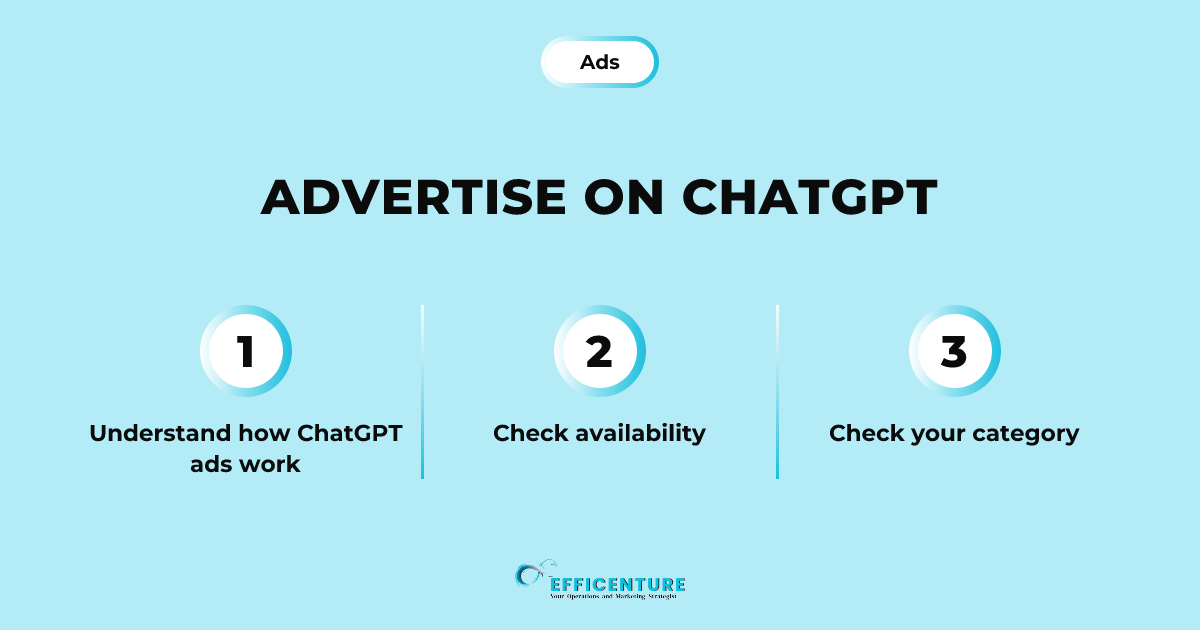
Step 1: Understand how ChatGPT ads work
Before planning a campaign, understand the format and its limits.
- Placement: ads appear below ChatGPT's response when a relevant sponsored product or service matches the conversation.
- Separation: OpenAI says ads are visually separate from answers and run on separate systems. Advertisers can't shape, rank or change ChatGPT's responses.
- Audience: users on the Free and Go plans. Plus, Pro, Business, Enterprise and Edu accounts don't see ads.
- Exclusions: no ads for accounts known or predicted to belong to people under 18, none alongside conversations about personal health, mental health or politics, and none in Temporary Chats.
This means your ad competes for attention right after someone has read a helpful answer. It needs to offer a clear next step that fits the conversation.
Step 2: Check availability
As of October 2026, OpenAI reported ads running in 89 countries, bought through its own Ads Manager or through technology partners. OpenAI's Ads Manager availability page lists Kenya as available for self-serve advertising.
For a Kenyan business:
- Make sure the business that advertises and pays is a legal entity based in Kenya or another listed country.
- Expect a review: Ads Manager is in beta, and OpenAI checks each advertiser and ad before it runs. Larger advertisers can also work with OpenAI's ads team or a technology partner.
- If you sell to customers in other supported markets, such as exporters or firms with regional clients, consider targeting those markets.
Step 3: Check your category
OpenAI excludes or restricts some categories, including many regulated and sensitive verticals. Read OpenAI's advertising policies for your industry before planning creative. Regulated professions in Kenya, such as advocates, also have their own advertising rules that apply on any platform.
Step 4: Choose one offer
A first test should focus on a single product or service where buyers ask detailed questions before deciding. Good candidates include:
- B2B services such as payroll, bookkeeping, logistics or IT support
- Software and digital tools
- Education and professional courses
- Solar, water and energy installations
- Travel packages and accommodation
- High-value home services and renovations
Write down the questions buyers ask before choosing this offer. These shape the ad, the landing page and how you judge relevance.
Step 5: Build the landing page
Your landing page matters more than usual, because ChatGPT users have just read a detailed answer. A thin page will feel like a step backwards.
A strong landing page:
- Opens with a direct answer to the buyer's main question
- Gives prices or price ranges in KES, or explains clearly how pricing works
- Explains the process and timeline
- Shows proof: experience, credentials, case studies or reviews where allowed
- Answers common objections in a short FAQ
- Makes the next step easy: a call, WhatsApp chat, booking or short form
- Loads quickly on mobile
Step 6: Set up tracking before you spend
ChatGPT ads measurement is still developing, so build your own.
- Tag the ad link with UTM parameters, for example a source of "chatgpt" and a medium of "paid".
- Track key events in GA4: form submissions, WhatsApp clicks and phone clicks.
- Record every enquiry in a lead log with its source and outcome.
- Ask new customers how they found you.
Without this, you won't be able to tell whether the test worked.
Step 7: Set up the campaign
The exact steps depend on whether you use Ads Manager or a partner, and OpenAI's interface is still evolving. In general you'll need to:
- Create an advertiser account with your business details and billing.
- Set up a campaign with a budget and schedule.
- Choose the bidding or pricing model offered in your market.
- Provide your creative: business name, headline, description, image where supported, and destination URL.
- Submit for review against OpenAI's ad policies.
Write creative that fits a conversation. Be specific, plain and helpful. "Payroll and KRA filings handled for SMEs in Kenya. See pricing" is clearer than "Kenya's leading HR solutions provider".
Step 8: Run a fixed, time-boxed test
- Budget: a fixed amount you're comfortable spending to learn.
- Duration: four to six weeks, long enough to collect meaningful results.
- Changes: keep changes minimal during the test, so results are clear.
- Follow-up: reply quickly to every enquiry. Leads from detailed conversations often expect detailed answers.
Step 9: Review the results
At the end of the test, compare ChatGPT ads with your other channels for the same offer:
- Clicks and cost per click, if available
- Enquiries and cost per enquiry
- Share of enquiries that were good fits
- Customers won and cost per customer
- Quality of conversations: were these buyers better informed or further along?
If cost per customer is acceptable, extend the test to a second offer or increase budget gradually. If not, you've spent a small, known amount and learned how your buyers respond to this channel.
Step 10: Keep improving the foundations
Whatever the result, the work behind the test pays off elsewhere. Pages that answer buyer questions clearly improve Google Ads conversion rates and help your business appear in organic AI answers. Consistent business details, structured data and credible reviews support visibility across search and AI tools.
Common mistakes
- Buying before tracking is in place
- Sending clicks to the home page instead of a page that answers the question
- Generic creative that doesn't fit a conversation
- Expecting Google-level volume from a newer, smaller channel
- Ignoring category rules, both OpenAI's and your profession's
- Judging too early, before the test has run its course
How should you write ChatGPT ad copy?
Ad copy for ChatGPT has to work right after a helpful, detailed answer. A few principles help.
- Name the service and who it's for: "Bookkeeping for SMEs in Kenya" is clearer than "Accounting solutions".
- Add one concrete detail: a price range, a timeline, a location or a guarantee you can honour.
- Offer a natural next step: "See pricing", "Compare packages", "Book a 15-minute call".
- Stay factual. Avoid "best", "leading" and other unsupported claims, which also fall foul of many platforms' policies and some professions' rules.
- Match the landing page. The page should deliver exactly what the ad promised.
Examples of weak and stronger copy
- Weak: "Kenya's top solar company. Contact us today!"
- Stronger: "Home solar for Kiambu homes. Free site visit and written quote in 48 hours."
- Weak: "Innovative HR solutions for modern businesses."
- Stronger: "Payroll and statutory filings for teams of 10 to 200. See monthly pricing."
Who on your team should be involved?
A first test touches several people:
- The owner or manager approves the offer, budget and claims.
- Whoever runs marketing sets up the campaign, creative and tracking, or briefs a partner.
- Your web developer builds or updates the landing page and checks tracking.
- Sales or customer service replies to enquiries quickly and records outcomes.
Agree roles before launch, and hold a short weekly check-in during the test.
What should you do after the test?
Write a one-page summary: what you tested, what it cost, what it produced and what you learned. Even if you decide not to continue, the summary saves time when you revisit the channel later, when pricing, tools and availability may have changed.
How do you keep up with changes?
OpenAI has updated its ad rules and tools several times since testing began. Before each new campaign, check the help centre for current placement rules, excluded audiences and categories, review the pricing options in your market, and confirm that your tracking still works. A short checklist saves you from planning around rules that no longer apply.
How Efficenture can help
Efficenture helps businesses decide whether ChatGPT ads fit, prepares landing pages and tracking, and runs careful tests alongside Google and Meta campaigns. Learn more about our ChatGPT Ads service, or our analytics and reporting for measuring results.
We're based in Nairobi and work with businesses across Kenya and East Africa. Book a consultation and we'll help you plan a first test.
Frequently asked questions
How do I start advertising on ChatGPT?
Check whether your business and target market are supported in OpenAI's Ads Manager or through a technology partner, choose one offer, build a landing page that answers the buyer's question, set up tracking, and run a small time-boxed test.
Can Kenyan businesses advertise on ChatGPT?
Yes. OpenAI's Ads Manager availability page lists Kenya as available for self-serve advertising. The advertiser must be a legal entity based in a listed country, and OpenAI reviews each advertiser and ad before it runs.
Where do ChatGPT ads appear?
Below ChatGPT's response, when a relevant sponsored product or service matches the conversation. They're labelled as sponsored and kept separate from the answer.
What should a ChatGPT ad link to?
A landing page that directly answers the buyer's question, with prices or pricing information, process, proof and an easy next step such as WhatsApp, a call or a booking.
How do I measure ChatGPT ads?
Tag ad links with UTM parameters, track enquiries, WhatsApp clicks and calls as key events in GA4, record outcomes in a lead log, and compare cost per customer with your other channels.
Weekly Insights
One useful idea a week, on what you care about
A two-minute weekly briefing for growing businesses: the insight worth knowing on each topic you pick, why it matters, one thing to do that week, and the guides that go deeper. Unsubscribe any time.