Management Consulting in Kenya: A Practical Operations Guide
A practical guide to management consulting in Kenya, detailing how operational changes turn business strategy into efficient execution and profit.
Management consulting in Kenya helps organisations improve performance by assessing existing operational problems and developing structured plans for improvement. While global advisory firms often focus on corporate board strategy or financial audits, operational management consulting addresses daily execution, workflow design, and team alignment. Businesses across Kenya and East Africa hire consultants to eliminate waste, link departmental efforts, and build systems that support profitable growth.
If your business has outgrown its initial setup, bringing in specialized operations management consulting gives you an objective view of where staff time, cash flow, and operational capacity are being lost.
What Is Management Consulting in Kenya?
Management consulting in Kenya is an advisory service where external specialists analyze a company's structure, workflows, and operational methods to resolve inefficiencies. The goal is to improve business performance by providing objective analysis, practical operational frameworks, and implementation support that internal teams lack the time or expertise to build alone.
Many business leaders confuse management consulting with statutory auditing or legal representation. While an audit firm verifies financial statements and legal advisors focus on compliance, management consultants look at how work is organized and executed across departments. To understand how operational advisors work inside an organisation, read our guide on what operations management consultants do.
The market for management advisory in Kenya has expanded significantly. It is no longer limited to corporate institutions or international non-governmental organisations in Kenya. Growing mid-sized enterprises, family-owned distributors in regional hubs like Nakuru and Mombasa and fast-growing technology companies regularly hire advisors to solve specific execution problems.
How Management Consulting Differs from Accounting and Strategy Advisory
Management consulting covers several distinct disciplines, and choosing the wrong type of consultant often leads to wasted budget and unused reports. Traditional accounting firms in Kenya focus primarily on tax compliance, financial reporting, and internal controls. Strategy firms focus on executive market positioning, capital expansion, and board-level corporate restructuring.
Operational management consulting sits directly between board strategy and daily work. It translates strategic goals into concrete operational procedures that employees execute every day.
For example, a strategy firm might advise a retail distributor in Kenya to expand into neighbouring East African markets. An operational consultant, on the other hand, sets up the inventory tracking systems, standardizes order processing rules, and establishes clear handoff procedures between customer service, warehouse staff, and delivery teams. Without operational alignment, strategic expansion plans quickly fail due to customer churn, order errors, and unmanaged overheads.
When evaluating your business needs, remember that strategy tells you where your company should go, while operations management ensures your internal engine can handle the trip.
How Much Does Management Consulting Cost in Kenya?
Management consulting fees in Kenya vary based on the size of the business, the complexity of internal operations, and the duration of the engagement. Consulting firms in Kenya generally structure their pricing through fixed project fees, ongoing monthly retainers, or daily advisory rates.
For small to medium-sized Kenyan enterprises, consulting costs typically fall within three main pricing models:
Project-Based Pricing
Management consulting project fees vary by project scope; check current rate estimates on consulting firm platforms or request custom quotes. The total fee depends on the number of operational departments included, the depth of system integration required, and the size of the staff team being trained.
Monthly Advisory Retainers
Growing companies that require continuous operational oversight, regular management reviews, and workflow tracking often prefer a monthly retainer model. Monthly fees vary depending on the scope and firm; check current retainer rate guides for accurate pricing.
Daily and Hourly Advisory Rates
Hourly rates for short-term operational assessments and workshops vary; check current consultant rate guides for specific pricing. Full-day advisory rates for senior operations consultants vary; check current professional rate guides or consult directly with firms.
Pricing is primarily influenced by the level of execution involved. Consulting firms that stay on site to train your staff, test operational changes, and monitor performance charge more than firms that simply deliver a slide deck and leave.
Common Operational Bottlenecks in Kenyan Businesses
Operational management consultants in Kenya are usually called in when internal breakdowns start impacting company profit or customer retention. As businesses expand beyond their founding teams, informal ways of working begin to break down under increased transaction volumes.
Here are four common operational bottlenecks that indicate your business needs management advisory support:
The Marketing and Operations Mismatch
A major breakdown occurs when sales and marketing teams generate leads faster than operational teams can handle them. If your ad campaigns attract hundreds of inquiries on WhatsApp or phone calls, but your sales team takes two days to respond, prospect interest quickly drops. If you suspect your client acquisition setup has structural gaps, run a free marketing audit to pinpoint operational breakdowns between customer inquiry and sales contact.
Delayed Fulfillment and Manual Data Errors
Many growing Kenyan businesses rely heavily on manual record-keeping, copying data between spreadsheets, paper receipts, and M-Pesa notifications. This manual approach inevitably leads to misplaced orders, double-billed clients, inventory discrepancies, and late deliveries.
Over-Reliance on Business Owners
When a company relies entirely on the founder to approve routine purchase orders, assign daily tasks, or resolve minor customer complaints, operational velocity slows to a crawl. Management consulting helps structure delegation frameworks so team leads can make operational decisions using clear rules.
Unplanned Scaling Costs
Expanding a business without optimizing operational workflows leads to rising overheads that consume all new margin. If adding thirty percent more sales doubles your operational overhead, your operational structure is inefficient. To understand how to grow output without ballooning overhead, read our detailed guide on how to scale a small business in Kenya.
How Operational Management Consulting Fixes Workflow Disconnects
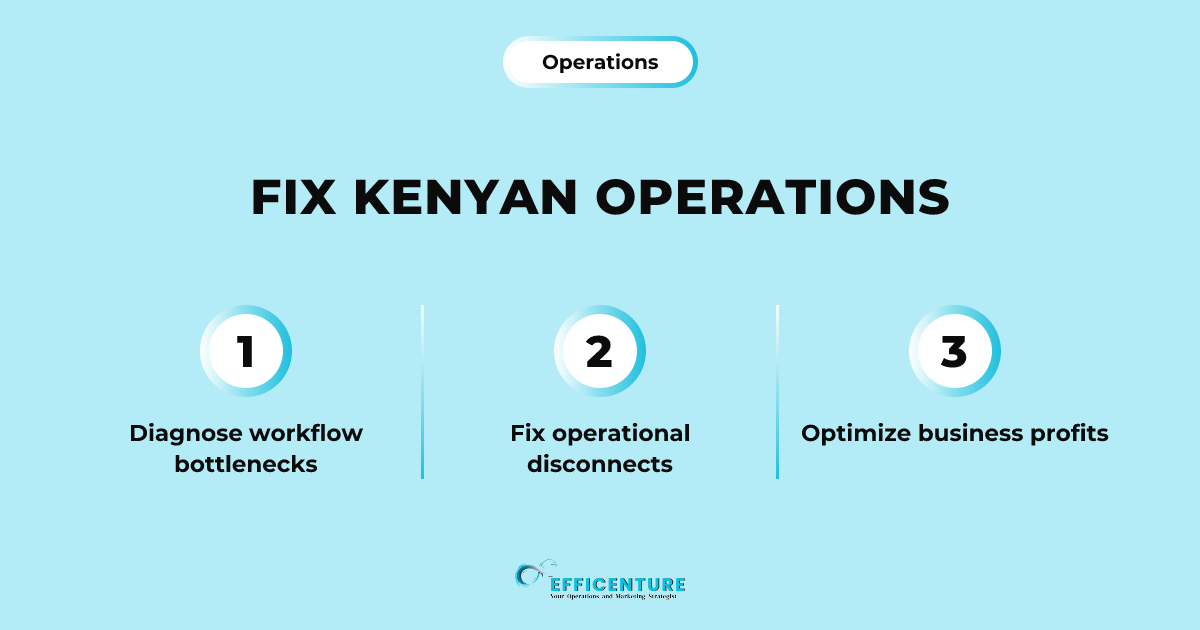
Operations consulting addresses these bottlenecks by systematically examining every touchpoint in your business model. Rather than making vague recommendations, operational advisors look at how information, tasks, and money flow through your organization.
A major focus of modern management advisory is resolving hidden friction between front-line customer acquisition and back-office order processing. When sales representatives make commitments that warehouse or service teams cannot meet, internal tension rises and service delivery suffers. You can read more about how this operational tension damages profit margins in our analysis of the gap between marketing and operations.
Operational management consultants resolve these issues by creating clear service-level agreements between internal departments. By defining precise handoff protocols, establishing mandatory response times, and standardizing task ownership, businesses reduce operational friction and deliver consistent service.
The Four Stages of a Management Consulting Engagement
A structured management consulting engagement follows a clear four-stage process designed to bring measurable improvements to your operations. Each phase builds upon practical evidence collected directly from your team's day-to-day activities.
1. Operational Diagnostic and Process Mapping
The engagement starts with a thorough review of your current operations. The consultant interviews staff members, reviews daily tasks, maps communication paths, and observes how orders, client queries, and payments are managed. This diagnostic phase identifies exact bottleneck points, duplicate administrative tasks, and unassigned operational responsibilities.
2. Workflow Redesign and Process Standardization
Using data gathered during the diagnostic phase, the consultant redesigns inefficient workflows. Complex steps are simplified, redundant administrative loops are removed, and new standard operating procedures are written out clearly. Standardisation ensures that every team member follows identical steps, producing consistent quality regardless of who is working that shift.
3. System Integration and Performance Tracking
New operational procedures are connected to appropriate tools, automated reporting systems, or management dashboards. Implementing professional analytics and reporting services ensures business owners can monitor operational efficiency, order processing times, and team throughput in real time without manually building daily spreadsheets.
4. Implementation, Staff Training, and Refinement
The final stage focuses on practical execution within your active business environment. The consultant guides your leadership team through the rollout, trains staff on updated workflows, monitors initial adoption, and adjusts procedures based on actual operational feedback.
How to Choose the Right Management Consulting Firm in Kenya
Selecting the right management consulting partner in Kenya requires careful evaluation of their practical experience, regional understanding, and focus on implementation. You need an advisory team that understands local business realities rather than one offering theoretical advice developed for foreign markets.
When evaluating management consulting options, consider these essential selection factors:
Practical Execution Focus
Ask prospective advisors whether their work ends with presenting a diagnostic report or if they remain involved to train your team and guide implementation. True operational improvements happen during the implementation phase, not during the initial presentation.
East African Market Context
Ensure the consulting team understands the realities of operating within Kenya and the wider East African region. Local factors like M-Pesa payment integration, regional supply chain delays, county business regulations, and local workplace dynamics require practical, adaptable approaches.
Focus on Measurable Performance Metrics
Choose a consultancy that grounds every operational project in clear performance metrics. Establishing a structured measurement strategy at the start of the engagement ensures that project success is measured by concrete operational improvements, such as faster order processing times or reduced operating costs.
Pragmatic Project Scope
Avoid advisory firms that propose complete, company-wide restructuring all at once. Effective operational consulting focuses first on the primary bottleneck causing the greatest operational delay or financial loss, delivering clear performance gains before tackling secondary procedures.
Work With Efficenture to Optimize Your Business Operations
Efficenture is an operations and digital marketing consultancy based in Nairobi, Kenya. We work with Kenyan and East African businesses to eliminate internal bottlenecks, bridge departmental gaps, and build operational workflows that support scalable profit.
If operational inefficiencies, disjointed workflows, or uncoordinated teams are slowing down your company's growth, explore our specialized operations management consulting services to see how we can help your team execute more efficiently.
To discuss your operational challenges with an experienced consultant, call or WhatsApp us on +254 714 146 122 today.
Frequently asked questions
What is the difference between management consulting and accounting?
Accounting firms focus on tax compliance, financial reporting, and internal controls. Management consultants look at how work is organized, structured, and executed across departments to improve daily operations.
How do consulting firms in Kenya charge for their services?
They generally structure their pricing through fixed project fees, ongoing monthly retainers, or daily and hourly advisory rates depending on the scope of work.
When should a Kenyan business hire an operational consultant?
You should hire a consultant when internal breakdowns impact profit or customer retention, such as when sales outpace fulfillment, manual data errors increase, or the business owner is overwhelmed by daily approvals.
How long does a typical management consulting engagement last?
The duration depends on project scope, company size, and the level of implementation support needed to train staff and test operational changes.
Why is local market experience important when hiring consultants in Kenya?
Local advisors understand specific regional realities like M-Pesa integration, supply chain delays, county regulations, and workplace dynamics in East Africa.
Weekly Insights
One useful idea a week, on what you care about
A two-minute weekly briefing for growing businesses: the insight worth knowing on each topic you pick, why it matters, one thing to do that week, and the guides that go deeper. Unsubscribe any time.